
Voting as a Christian: What Does Jesus Say About Political Leaders?
A biblical perspective on voting, political parties, character, forgiveness, and choosing leaders according to God’s Word.
Politics has become one of the most divisive subjects in America. Families argue, friendships end, and even Christians turn against one another because of political differences. But here’s a question every Christian should consider:
Are we allowing our faith to guide our political decisions, or are we allowing politics to influence our faith?
Voting shouldn’t simply be about being a Republican or Democrat. It shouldn’t be about voting against someone because you dislike their personality, something they said years ago, or what you’ve heard about them on television or social media.
As Christians, we should be willing to look deeper.
- What does a candidate believe?
- What policies do they support?
- How do their decisions affect others?
- What does their character reveal?
- And how do we evaluate those things according to Scripture?
Voting as a Christian means considering our faith, biblical values, and the character of those seeking political office. The Bible doesn’t tell us which political party to support. It does, however, teach us about righteousness, justice, truth, forgiveness, humility, and leadership. Most importantly, our loyalty to Jesus Christ should never be replaced by loyalty to a political leader.
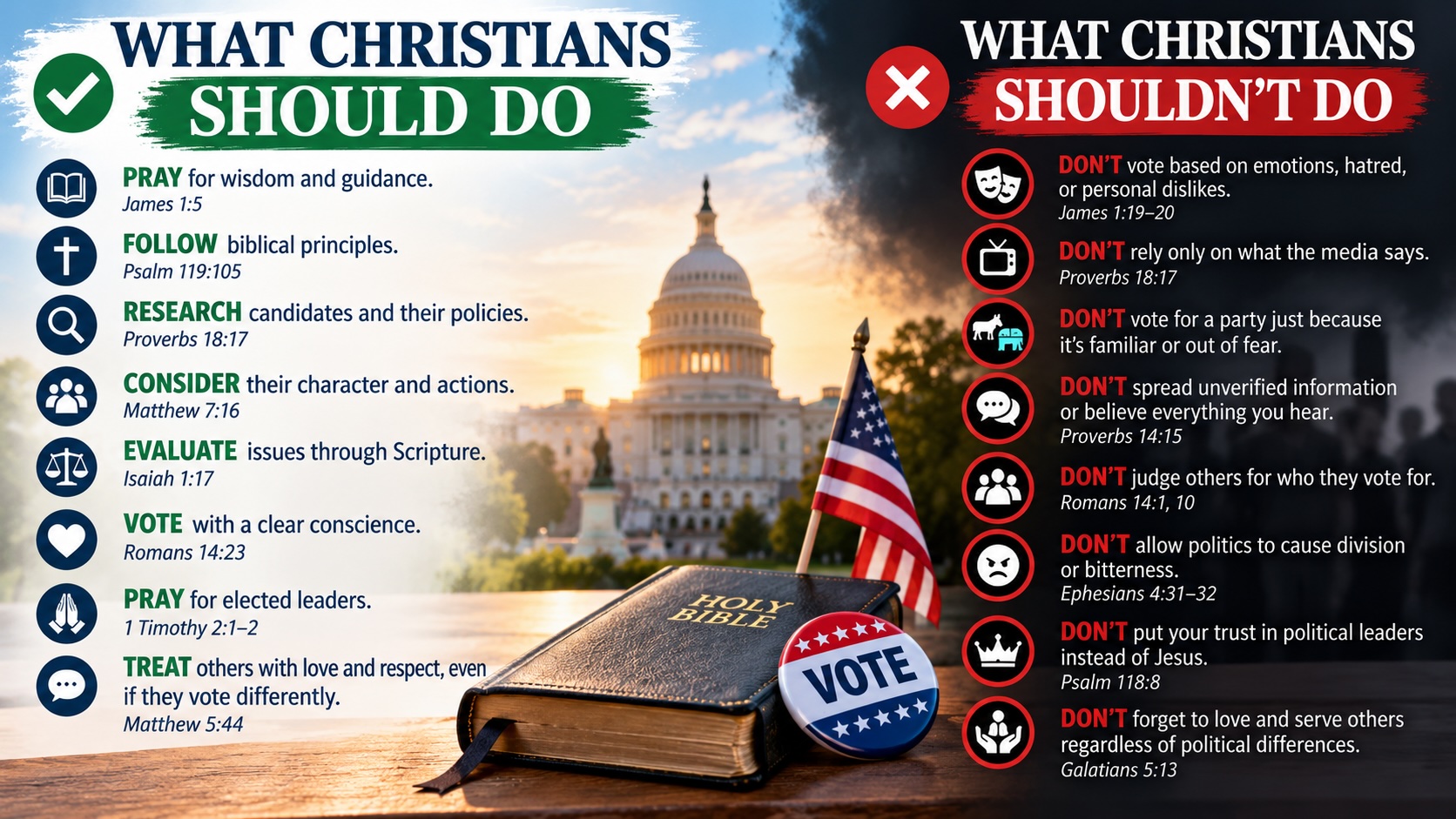
1. Voting as a Christian: Follow Biblical Principles, Not Political Parties
Political parties are created by people. God’s Word is not. Political platforms can change. Candidates come and go. The issues dominating an election today may be entirely different in four years. But God’s Word remains.
Isaiah 40:8 (NIV) reminds us:
“The grass withers and the flowers fall, but the word of our God endures forever.” – Isaiah 40:8
Following Jesus requires conviction, even when the world disagrees. As Christians, we are called to stand firm in our faith and remain faithful to God’s Word rather than allowing popular opinion to determine what we believe.
For Christians, Scripture offers a foundation for thinking about right and wrong, justice, compassion, honesty, personal responsibility, and the treatment of others. That doesn’t mean every political issue has a simple biblical answer. Christians can agree on a moral principle while disagreeing about which government policy best puts it into practice. Christian voting principles remind us to examine political candidates through the teachings of Scripture rather than relying solely on party affiliation.
Instead of automatically supporting one party or rejecting another, we can examine what candidates actually propose and what they have done while serving in public office. A political party is not our identity in Christ.
2. Stop Expecting Political Candidates to Be Perfect — We Are All Sinners
One of the biggest problems in politics is how quickly people condemn others for their past mistakes.
We see old interviews, controversial statements, accusations, and stories about things someone did decades ago. Sometimes those stories reveal serious wrongdoing that deserves accountability. Other times, they leave out important context or fail to acknowledge how someone has changed.
Romans 3:23 (NIV) says:
“for all have sinned and fall short of the glory of God” – Romans 3:23
None of us is beyond the need for God’s mercy. Understanding the power of forgiveness reminds us that although sin has consequences, repentance and genuine transformation are possible through Jesus Christ.
That includes politicians. It includes pastors, teachers, neighbors, family members, and every one of us. Imagine if every mistake you ever made became public knowledge. Would you want people to judge your entire life by your worst moment?
The Bible teaches forgiveness, but it also teaches responsibility. A person’s past can be relevant when considering whether to trust them with public authority. Yet it is also worth asking whether they have acknowledged wrongdoing, demonstrated genuine change, and shown consistent behavior over time.
Forgiveness does not mean pretending wrongdoing never happened. And accountability does not mean believing someone is incapable of change.
3. God Used Imperfect People Throughout the Bible
One thing the Bible makes very clear is that God doesn’t only use people with perfect pasts. If He did, He wouldn’t have anyone to work with. Throughout Scripture, God called people who had sinned, made terrible decisions, struggled with doubt, or were rejected by society. Some were murderers. Some were dishonest. Some denied Jesus. Others ran from God or didn’t believe they were worthy of His calling. Yet God still used them.
- Moses — A man who killed another man. In Exodus 2:11–12, Moses killed an Egyptian and fled. Years later, God called Moses to lead His people out of slavery. Moses even questioned his own abilities and asked God to send someone else (Exodus 4:10–13). God knew Moses’ past, his fears, and his weaknesses. Yet He still called him.
- David — A king who committed adultery and murder. In 2 Samuel 11, David committed terrible sins involving Bathsheba and Uriah. When confronted by Nathan, David acknowledged his sin. Psalm 51 records his plea for mercy. But notice something important: David was forgiven, yet he still faced serious consequences for his actions. God’s forgiveness does not mean our actions have no consequences.
- Paul — A man who persecuted Christians Before becoming an apostle. Before becoming one of Christianity’s most influential apostles, Paul, originally known as Saul, persecuted Christians. He approved of Stephen’s death (Acts 8:1) and sought to imprison followers of Jesus. But in Acts 9, Paul encountered the risen Jesus on the road to Damascus. His life changed dramatically. The man who once persecuted Christians became a missionary who spread the Gospel and wrote many of the letters found in the New Testament. Imagine if everyone had refused to believe Paul could change because of his past.
- Matthew – A tax collector who became a disciple of Jesus. Matthew is a particularly meaningful example because Jesus personally called him. In biblical times, tax collectors were widely disliked. They collected taxes for the Roman government, and some were known for dishonesty and taking more money than required. Matthew worked as a tax collector before becoming one of Jesus’ twelve apostles. Jesus knew Matthew’s occupation and the reputation associated with it. Yet He called Matthew to follow Him (Matthew 9:9). When religious leaders questioned why Jesus ate with tax collectors and sinners, Jesus responded in Matthew 9:12–13 that He had come to call sinners, not those who considered themselves righteous. Matthew’s story reminds us that Jesus sees beyond a person’s reputation and offers an opportunity for a different life.
- Peter — A disciple who denied Jesus three times. Peter walked with Jesus, witnessed His miracles, and heard His teachings firsthand. Yet when Jesus was arrested, Peter denied knowing Him three times. Jesus knew that Peter would deny Him (Matthew 26:31-35). Peter denies knowing Jesus in Matthew 26:69-75 and Luke 22:54-62. But that wasn’t the end of Peter’s story. After His resurrection, Jesus restored Peter and entrusted him with caring for His followers (John 21:15–19). Peter later boldly preached the Gospel, including on the day of Pentecost in Acts 2. One moment of failure did not define Peter’s entire life.
- Rahab — A prostitute who demonstrated faith. Rahab lived in Jericho and was identified in Scripture as a prostitute. Yet when Israelite spies came to Jericho, she protected them because she recognized the power of Israel’s God. Her story is found in Joshua 2. Rahab is later mentioned in Hebrews 11:31 among those commended for their faith. She is also included in the genealogy of Jesus in Matthew 1:5. Think about that. A woman whose past might have caused society to reject her became part of the family line of Jesus Christ.
- Jonah — A prophet who ran from God. God instructed Jonah to go to Nineveh and warn the people about their wickedness. Instead, Jonah ran in the opposite direction. His story is found in Jonah 1–4. After being swallowed by a great fish and eventually obeying God’s instructions, Jonah delivered God’s warning to Nineveh. The people repented, and God showed them mercy. Yet Jonah became angry because God spared them. Jonah’s story reminds us that even people called to serve God can struggle with disobedience, resentment, and a lack of compassion.
- Thomas — A disciple who doubted the resurrection. Thomas was one of Jesus’ twelve disciples, yet he struggled to believe that Jesus had risen from the dead. In John 20:24–29, Thomas said he needed to see the wounds in Jesus’ hands and side before he would believe. Jesus later appeared to Thomas and invited him to examine the evidence. Thomas responded by acknowledging Jesus as his Lord and God. Even someone who had walked with Jesus struggled with doubt.
- Jacob — A man who deceived his own family. Jacob deceived his father Isaac and obtained the blessing intended for his brother Esau. You can read this account in Genesis 27. Yet God continued working through Jacob’s life. In Genesis 32:28, Jacob received the name Israel, and his descendants became the twelve tribes of Israel. Jacob’s story includes deception, family conflict, struggle, and transformation.
- The Woman at the Well — Someone Jesus did not reject. In John 4:1–42, Jesus spoke with a Samaritan woman whose personal history included five husbands and a current relationship with a man who was not her husband. Rather than refusing to speak with her, Jesus engaged her in a conversation about living water and true worship. Afterward, she told people in her town about Jesus, and many came to believe. Jesus knew her history, yet He still spoke to her with truth and offered her living water. Her encounter with Jesus shows that a complicated past does not prevent someone from responding to Him and sharing what they have learned.
These biblical accounts remind us that Jesus did not come only for people with spotless reputations. Understanding who Jesus Christ is helps us recognize why forgiveness, repentance, and changed lives are so central to the Christian faith.
What Can We Learn From These Biblical Examples?
Look at the people God used:
-
Moses killed a man.
-
David committed adultery and arranged a murder.
-
Matthew was a tax collector with a socially despised occupation.
-
Paul persecuted Christians.
-
Peter denied Jesus three times.
-
Rahab was a prostitute.
-
Jonah disobeyed God.
-
Thomas doubted the resurrection.
-
Jacob deceived his family.
-
The Samaritan woman had a complicated personal history.
Yet their stories didn’t end with their mistakes, struggles, or reputations. God knew their past. He knew their weaknesses. And He still worked through their lives. Does this mean we should ignore someone’s past, excuse wrongdoing, or assume every person who claims to have changed truly has? Absolutely not.
Scripture teaches repentance, accountability, wisdom, and the importance of examining a person’s actions. But it also teaches that people can change. And that brings us back to how we think about political leaders. A candidate’s past may tell us something important about their character. Their present conduct, honesty, policies, and willingness to take responsibility matter too.
We shouldn’t automatically dismiss someone because of an old mistake, nor should we excuse serious wrongdoing simply because we support their political positions. The question isn’t whether someone has ever sinned. We already know the answer to that. The question is what their life and actions reveal about who they are today. And remember what Jesus said in John 8:7 (NIV):
“Let any one of you who is without sin be the first to throw a stone at her.” – John 8:7
Jesus taught mercy without pretending sin didn’t matter. That is an important distinction for Christians to remember, whether we’re discussing political leaders, our neighbors, or ourselves.
4. What Did Jesus Say About Political Leaders?
When asking what does Jesus say about politics, we can look to His teachings about truth, authority, humility, and serving others. Jesus lived during a time of political oppression under Roman rule. Religious authorities and government leaders often exercised enormous power over ordinary people. Yet Jesus did not organize a political party or instruct His followers to take control of the Roman government. Instead, He taught principles that challenged how people understood authority, power, and leadership.
Jesus said leadership should be about serving others
In Mark 10:42–45, Jesus explained that rulers of the Gentiles exercised authority over others, but His disciples were to follow a different example. He taught that greatness comes through service. That raises an important question when considering any leader:
Does this person demonstrate a commitment to serving others, or is their leadership primarily about personal power?
Jesus taught us to recognize people by their fruit
16 By their fruit you will recognize them. Do people pick grapes from thornbushes, or figs from thistles? – Matthew 7:16
In context, Jesus was warning about false prophets. The broader principle of examining conduct rather than relying only on appearances is also relevant when thinking about character. A politician can deliver an impressive speech, make wonderful promises, and claim to believe in God. But words alone don’t establish integrity. Look at actions, decisions, honesty, and consistency.
Jesus taught us to judge correctly
“Stop judging by mere appearances, but instead judge correctly.” – John 7:24
This is especially meaningful in a world where headlines, edited videos, and social media posts can shape opinions before people know the complete story. Christians should value truth, including facts that challenge their existing opinions.
5. Don’t Let Political Hatred Make Your Decisions
It’s possible to become so focused on disliking one candidate that we stop carefully examining the alternatives. Political disagreements can become personal. People may dismiss everything one politician says while automatically defending another. But Scripture warns us about anger, hatred, and division.
James 1:19–20 teaches believers to be quick to listen, slow to speak, and slow to become angry. Matthew 5:44 records Jesus telling His followers to love their enemies and pray for those who persecute them. Jesus calls us to something greater than simply loving people who agree with us. Understanding the meaning of real love and agape love reminds us that Christian love extends even to those whose beliefs and opinions are different from our own.
These teachings do not require Christians to agree with every politician or policy. They do challenge us to consider how we speak about people with whom we disagree. You can oppose someone’s policies without hating that person. You can disagree with another Christian’s vote without questioning their love for Jesus.
6. Research Political Candidates — Don’t Believe Everything You Hear
Today, information spreads faster than ever. A short video clip can reach millions of people before anyone checks its original context. Political advertisements can emphasize favorable facts while leaving out inconvenient details. Social media commentary can blur the distinction between reporting and opinion. That doesn’t mean every news organization is dishonest. It means every source, including sources we personally agree with, deserves scrutiny.
Scripture repeatedly warns us about deception and the importance of testing what we hear. The same biblical principles discussed in how to recognize false prophets and false teachers remind us to seek truth rather than blindly accepting someone’s words.
Proverbs 18:17 teaches that the first person to present a case can appear right until another examines the matter.
In a lawsuit the first to speak seems right, until someone comes forward and cross-examines. – Proverbs 18:17
When researching political candidates, consider:
-
Their documented voting records, public statements, and policy proposals.
-
Their conduct in office, including decisions that benefited or harmed others.
-
Whether serious accusations are supported by reliable evidence.
-
Whether their current behavior supports claims of personal growth or change.
-
How different credible sources describe the same event.
Seeking truth means being willing to examine evidence even when it challenges the candidate or political party we favor.
7. What Does the Bible Say About Government Authority?
Romans 13:1–7 teaches that governing authorities have responsibilities within God’s established order, including maintaining justice and addressing wrongdoing. Paul also instructs Christians to show appropriate respect and fulfill their civic obligations. However, recognizing civil authority does not mean treating every decision made by a government as morally right.
In Acts 5:29, Peter and the apostles explain that obedience to God takes priority when human authorities demand something contrary to God’s commands.
29 Peter and the other apostles replied: “We must obey God rather than human beings! – Acts 5:29
Christians can respect an office, question a policy, challenge injustice, and remain faithful to Christ.
8. Should Christians Put Their Faith in Political Leaders?
One of the clearest lessons Jesus taught about earthly power came during His conversation with Pontius Pilate.
36 Jesus said, “My kingdom is not of this world. If it were, my servants would fight to prevent my arrest by the Jewish leaders. But now my kingdom is from another place.” – John 18:36
Jesus was explaining that His kingdom was fundamentally different from earthly political kingdoms.
Presidents, governors, senators, and other elected officials have important responsibilities. Their decisions can affect families, communities, religious freedom, economic opportunity, and the treatment of vulnerable people. But none of them can offer what Jesus offers. The principles of biblical leadership remind us that authority comes with responsibility, accountability, and a commitment to serving others.
No politician can forgive sins, provide eternal salvation, or take the place of Christ. Political leaders may influence our lives here on earth, but only Jesus offers eternal salvation. His words in John 14:6 explain why Jesus is the only way to heaven and why our ultimate hope must remain in Him. Political leaders are temporary. Jesus is eternal. And regardless of which political party holds power, Christians are still called to love their neighbors, speak truthfully, practice justice, and share the Gospel.
9. What If Christians Disagree About Politics?
Two Christians can read the same Bible, love the same Savior, and reach different conclusions about government policies or candidates. Why? Because applying moral principles to complex political decisions often involves questions of evidence, judgment, priorities, and consequences.
One person may emphasize a candidate’s policies. Another may place greater weight on their conduct in office or personal integrity. These disagreements do not automatically establish that one person has abandoned biblical truth.
Romans 14 addresses disagreements of conscience among believers, although it does not specifically discuss modern elections. Christians should be able to discuss difficult subjects without allowing politics to destroy their relationships.
Remember Jesus’ teaching in John 13:34–35: His disciples are to be recognized by their love for one another.
34 “A new command I give you: Love one another. As I have loved you, so you must love one another. 35 By this everyone will know that you are my disciples, if you love one another.” – John 13:34-35
That command doesn’t disappear during election season.
10. Pray for Our Leaders — Even the Ones You Didn’t Vote For
It’s easy to pray for a political leader when you agree with their decisions. It’s much harder when you disagree with nearly everything they stand for. Yet 1 Timothy 2:1–2 instructs Christians to pray for kings and all those in authority, so that people may live peaceful and godly lives.
I urge, then, first of all, that petitions, prayers, intercession and thanksgiving be made for all people— 2 for kings and all those in authority, that we may live peaceful and quiet lives in all godliness and holiness. – 1 Timothy 2:1-2
That includes leaders from different political parties. Praying for someone does not mean approving of everything they do. It means asking God to guide them toward wisdom, justice, truth, and responsible leadership. And perhaps it means asking God to help us approach political disagreements with more humility, patience, and understanding.
11. Bible Verses About Voting, Leadership, and Character
Although the Bible does not directly address modern democratic elections, these passages offer relevant principles.
| Scripture | Biblical principle |
|---|---|
| Proverbs 29:2 | Leadership and righteousness affect the people |
| Proverbs 11:14 | Wise counsel matters |
| Proverbs 18:17 | Examine evidence before accepting a claim |
| Matthew 7:16–20 | Recognize people by their fruit |
| John 7:24 | Judge correctly, not by appearances |
| Mark 10:42–45 | Leadership should involve service |
| Romans 3:23 | Everyone has sinned |
| James 1:19–20 | Listen carefully and control anger |
| 1 Timothy 2:1–2 | Pray for those in authority |
| John 18:36 | Christ’s kingdom is not of this world |
Although there are no specific Bible verses about voting in modern elections, Scripture provides valuable guidance about wisdom, character, justice, and leadership.
Frequently Asked Questions About Christianity and Voting
No. The Bible does not identify or endorse modern political parties. It provides moral teachings that Christians can apply when considering candidates, policies, and leadership.
Scripture teaches forgiveness and the possibility of genuine change. It also teaches accountability. A candidate’s past conduct, present behavior, and evidence of repentance can all be relevant when examining character.
The Bible does not establish a religious qualification for participation in modern democratic elections. Christians can consider a candidate’s qualifications, actions, policies, and integrity without assuming that a religious label guarantees good leadership.
Political disagreement is not automatically sinful. However, hatred, dishonesty, and mistreatment of others conflict with biblical teachings about love and truth.
Jesus acknowledged civil obligations in Mark 12:17, taught servant leadership in Mark 10:42–45, and explained that His kingdom is not of this world in John 18:36.
Yes. First Timothy 2:1–2 calls believers to pray for those in authority, not only leaders with whom they agree.
Final Thoughts: Our Faith Should Be Bigger Than Politics
Elections matter. Leadership matters. The decisions made by people in government can affect generations. But politics should never become more important to Christians than Jesus Christ.
We should care about truth, character, justice, mercy, forgiveness, and the way people treat one another. We should be willing to question the political party we usually support, examine claims about candidates we dislike, and acknowledge when people we agree with have done something wrong. And we should never forget that we are all sinners in need of God’s grace.
At the end of the day, no political leader is perfect, no political party represents the Kingdom of God, and no election can replace the hope we have in Jesus.
Our ultimate hope is not found in Washington, D.C. It is found in Jesus Christ.