The Birth of Jesus Timeline - History and Evidence

The Birth of Jesus Christ: The Biblical Account, Prophecy & Evidence

The birth of Jesus Christ is one of the most familiar stories in the Bible. A young woman named Mary. Joseph. Bethlehem. A manger. Shepherds watching their flocks. Angels proclaiming good news. Wise men following a star.

But Christians believe something far greater happened in Bethlehem.

God entered human history.

Jesus was not presented in Scripture merely as another child who would grow up to become a great religious teacher. The Bible identifies Him as the promised Messiah, the Son of God and Savior of the world.

For Christians, the birth of Jesus is not a fairy tale attached to Christmas. It is the beginning of the earthly life of the person at the center of the Christian faith.

And for those who doubt the story, questions are welcome.

Was Jesus really a historical person?
Was He actually born in Bethlehem?
Was Mary really a virgin?
Why are Matthew and Luke’s accounts different?
What about the census mentioned by Luke?
Were the wise men really at the manger?
Did Old Testament prophecy actually predict His coming?

Those are important questions.

Let’s look carefully at what the Bible actually says, what it does not say, and why Christians believe the birth of Jesus was a real event in history.
Jesus Existed Before Bethlehem

The story of Jesus does not actually begin with Mary in Nazareth. The Gospel of John takes us much further back:

“In the beginning was the Word, and the Word was with God, and the Word was God.” — John 1:1

Then John makes an extraordinary statement:

“The Word became flesh and made his dwelling among us.” — John 1:14

This is one of the central claims of Christianity.

Jesus did not simply begin to exist when Mary gave birth to Him. Christians believe that the eternal Son of God took upon Himself human nature and entered His own creation. This is called the Incarnation.

God did not merely send humanity another prophet. He sent His Son.

Paul later summarized it this way:

“When the set time had fully come, God sent his Son, born of a woman, born under the law.” — Galatians 4:4

The birth in Bethlehem was therefore both wonderfully ordinary and completely extraordinary:

  • Jesus was truly born of a woman.
  • He was a real baby.
  • He had a real mother.
  • He grew.
  • He became hungry and tired.
  • He lived in a real family in a real place during a recognizable period of human history.

Yet Scripture also declares that this child was the Son of God.

The Birth of Jesus Was Promised Before It Happened

One reason Christians believe the birth of Jesus has enormous significance is that the New Testament writers connect His arrival with promises found throughout the Old Testament.

The expectation of a coming Messiah did not begin after Jesus was born. It existed long before Bethlehem.

The Promised Descendant

From the earliest chapters of Genesis, Scripture begins developing the expectation that God would ultimately defeat evil and bring redemption. That promise becomes increasingly specific throughout the Old Testament.

  • The Messiah would be connected with Abraham.
  • He would come through the tribe of Judah.
  • He would be connected with the royal line of David.
  • And He would rule as God’s promised King.

This is why the genealogies at the beginning of Matthew and in Luke matter.

They are not meaningless lists of ancient names. They place Jesus inside the history of Israel.

Matthew begins:

“This is the genealogy of Jesus the Messiah the son of David, the son of Abraham.” — Matthew 1:1

Before Matthew tells us how Jesus was born, he tells us who Jesus is connected to.

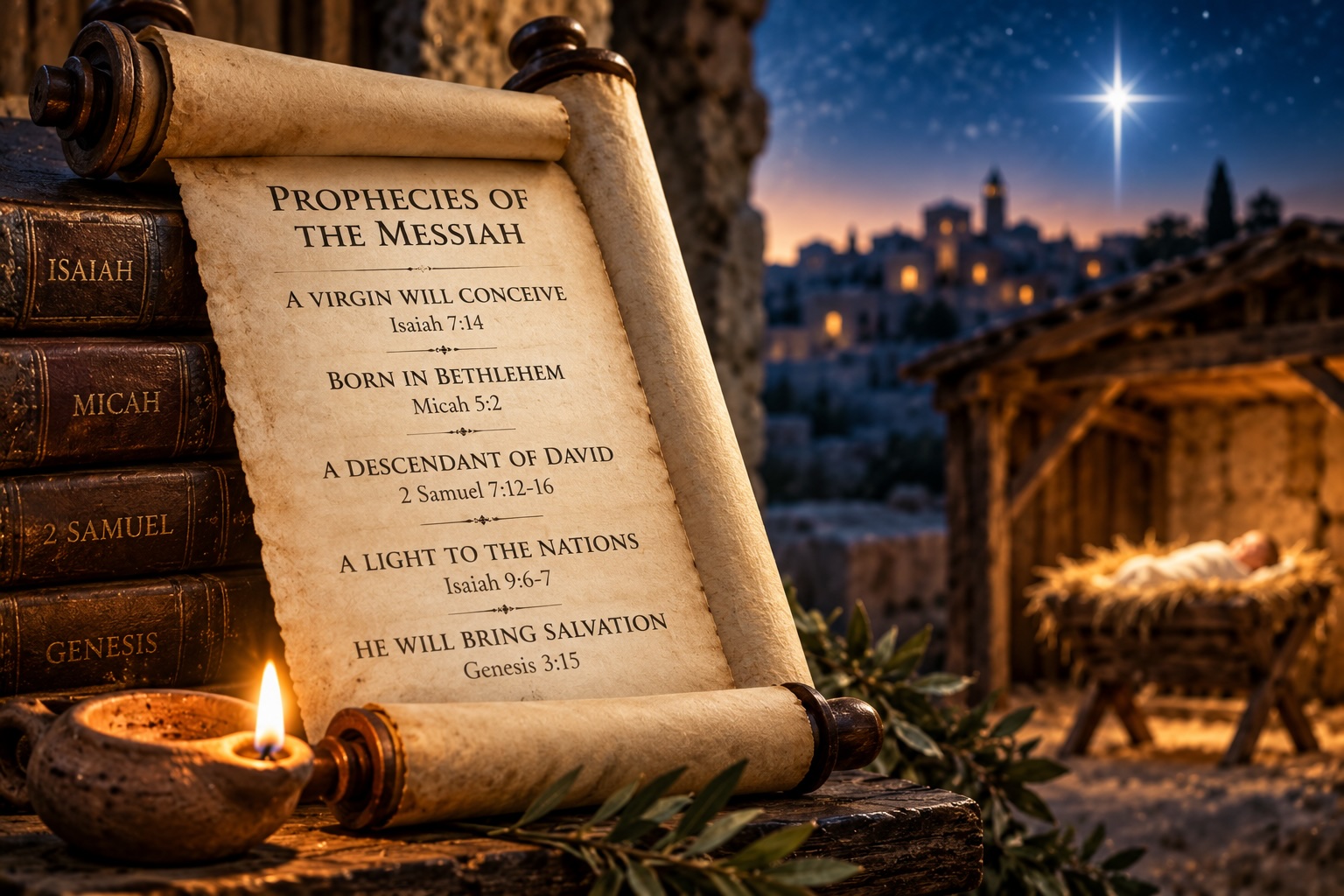
Prophesy of the Messiah - The birth of Jesus was promised before it happened.

The Messiah and the House of David

God promised King David that his royal line would have lasting significance. Centuries later, the prophets continued looking forward to a righteous ruler from David’s family.

Jeremiah wrote of a coming righteous Branch from David’s line who would reign wisely.

When Gabriel appeared to Mary, the angel specifically connected her future Son to that promise:

“The Lord God will give him the throne of his father David, and he will reign over Jacob’s descendants forever; his kingdom will never end.” — Luke 1:32–33

Joseph is also specifically identified as belonging to the house of David. That becomes especially important when the story reaches Bethlehem.

Why Bethlehem Matters

Approximately seven centuries before Jesus, the prophet Micah associated a future ruler of Israel with Bethlehem.

“But you, Bethlehem Ephrathah, though you are small among the clans of Judah, out of you will come for me one who will be ruler over Israel.” — Micah 5:2

Bethlehem was not the political center of Israel. Jerusalem was far more important. Yet Bethlehem carried another important distinction:

It was the city of David.

According to Luke, Joseph traveled from Nazareth to Bethlehem because he belonged to the house and line of David. And while Mary and Joseph were there, Jesus was born. Matthew independently places Jesus’ birth in Bethlehem as well.

That small Judean town therefore becomes central to the Christian story.

Gabriel Appears to Mary

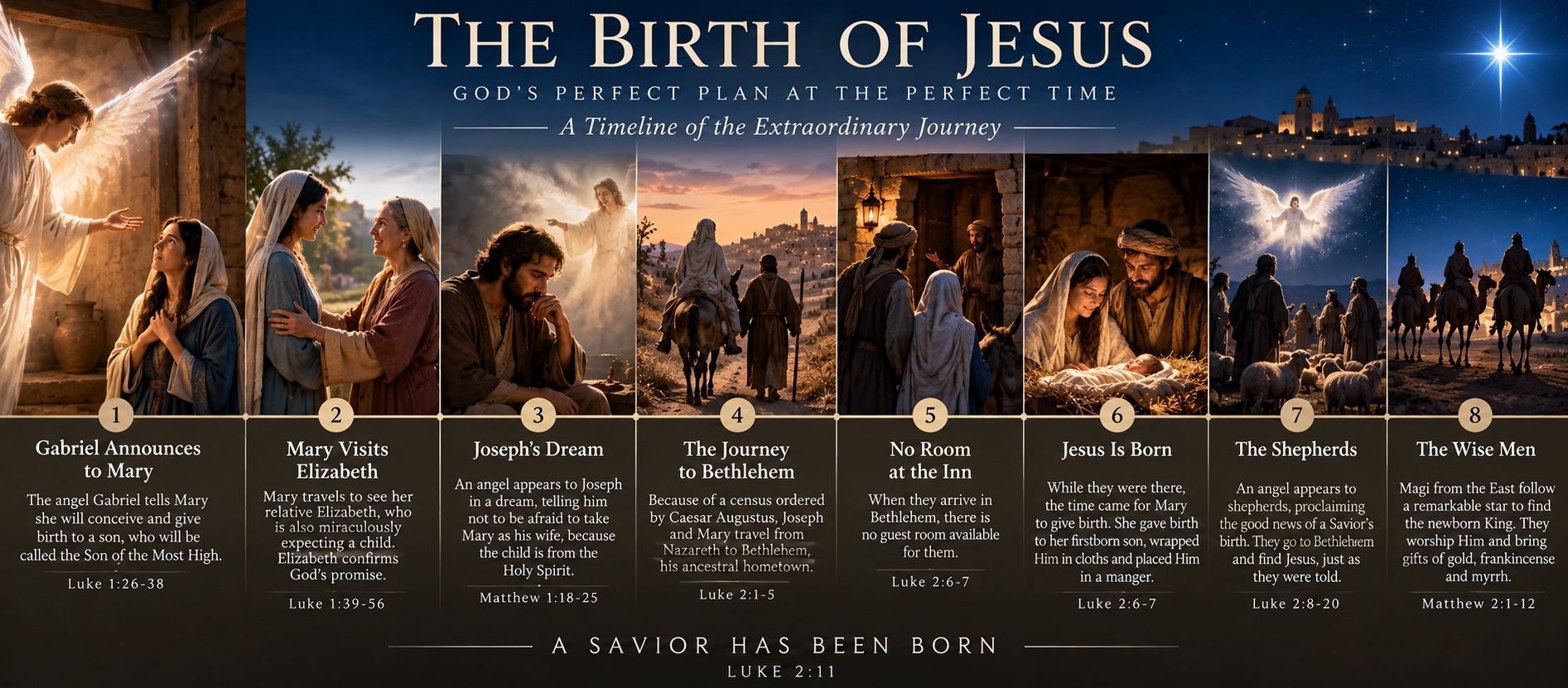
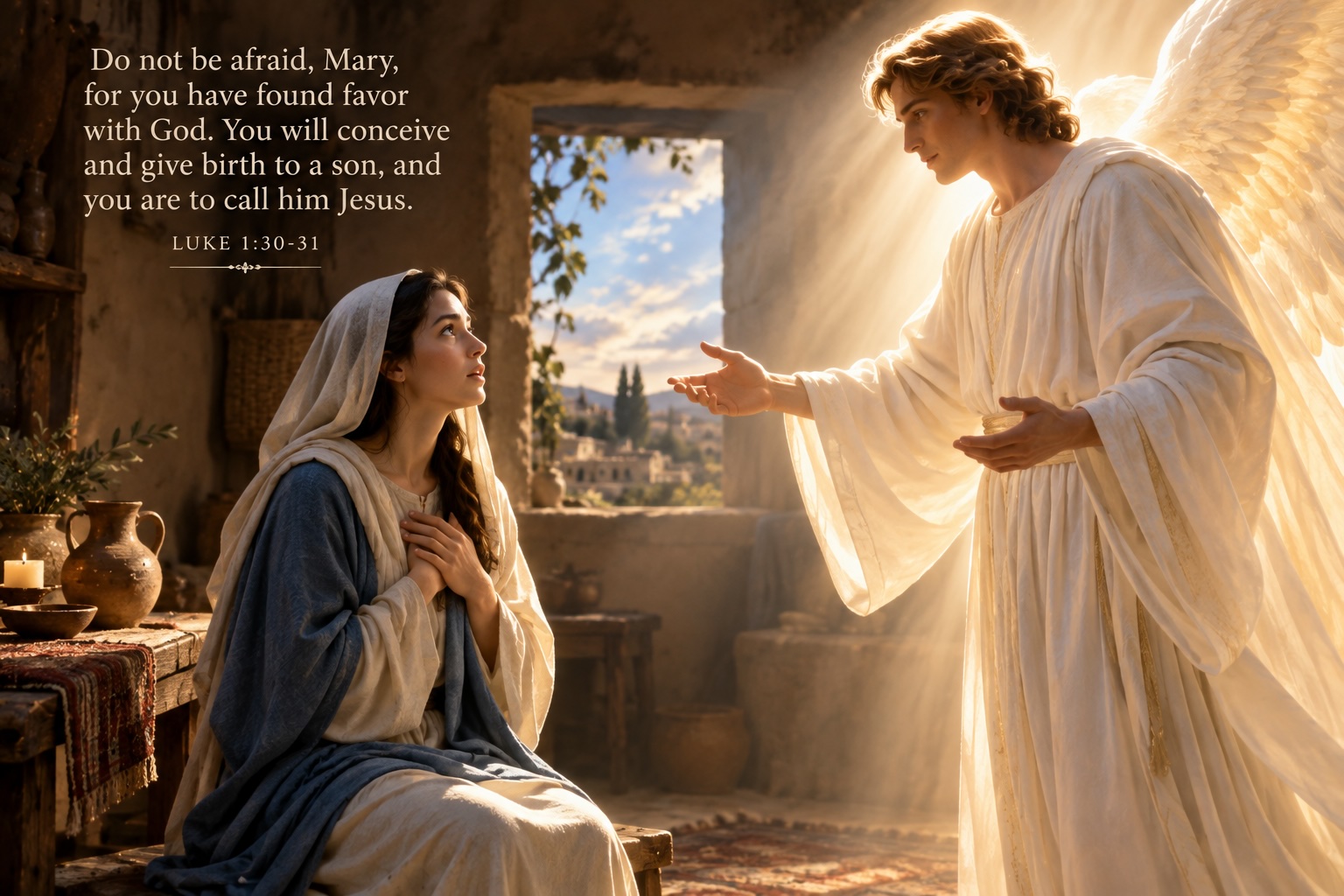
Luke begins his account before Jesus’ birth. The angel Gabriel is sent by God to a young woman named Mary in Nazareth. Mary was pledged to marry Joseph. Gabriel tells her that she will conceive and give birth to a son named Jesus.

  • He will be great.
  • He will be called the Son of the Most High.
  • He will receive David’s throne.
  • His kingdom will never end.

Mary immediately sees the obvious problem. She asks:

“How will this be, since I am a virgin?” — Luke 1:34

That question is important. Luke’s account does not accidentally overlook the biological impossibility.

The impossibility is part of the story.

Gabriel explains that the conception will be the work of God:

“The Holy Spirit will come on you, and the power of the Most High will overshadow you. So the holy one to be born will be called the Son of God” — Luke 1:35

Then comes the statement that summarizes the entire announcement:

“For no word from God will ever fail.” — Luke 1:37

Mary responds in faith and obedience.

The angel Gabriel appears to Mary

Was Jesus Really Born of a Virgin?

This is understandably one of the greatest objections skeptics raise. Human beings are not naturally conceived without a biological father. Christianity does not dispute that fact.

That is precisely why the Bible describes Jesus’ conception as a miracle.

If God does not exist, a virgin conception is impossible. But if the God who created human life exists, then the question changes. It is no longer: “Can this happen naturally?” The Christian answer is clearly no. The real question becomes:

Could the Creator of human life cause a human life to begin miraculously? Christianity answers yes.

The virgin birth is therefore inseparable from the larger question of whether God exists and whether He acts within His creation.

Matthew Gives Us Joseph’s Side of the Story

One fascinating feature of the birth narratives is that Luke concentrates heavily on Mary’s experience, while Matthew gives us important details about Joseph.

Mary becomes pregnant before she and Joseph have come together sexually. Imagine Joseph discovering this. From an ordinary human perspective, there was an obvious explanation. Mary had apparently been unfaithful. Matthew tells us Joseph intended to end the relationship quietly rather than expose Mary publicly.

Then something happened that changed his decision. An angel appeared to Joseph in a dream and told him:

“Do not be afraid to take Mary home as your wife, because what is conceived in her is from the Holy Spirit.” — Matthew 1:20

Joseph obeyed. Matthew then makes another detail unmistakably clear: Joseph did not consummate the marriage until after Jesus was born.

The Gospel writers are therefore not ambiguous about what they are claiming.

Mary was a virgin when Jesus was conceived. Matthew and Luke both affirm it from different perspectives.

Why Was He Named Jesus?

The angel told Joseph:

“You are to give him the name Jesus, because he will save his people from their sins.” — Matthew 1:21

The name Jesus is related to the Hebrew name Joshua and carries the meaning “The LORD saves.” His name points toward His mission. Jesus did not come simply to improve society, establish a philosophy or teach people to be kinder. He came to save.

The manger ultimately points toward the cross.

Immanuel — God With Us

Matthew connects Jesus’ birth with Isaiah 7:14:

“The virgin will conceive and give birth to a son, and they will call him Immanuel.” — Matthew 1:23

Matthew immediately explains the meaning: “God with us.” This is the heart of Christmas.

The Christian claim is not simply that a remarkable teacher was born. It is that God came to us.

  1. The eternal Word became flesh.
  2. The Creator entered His creation.
  3. The King came as a child.

Mary and Joseph Travel to Bethlehem

Luke places the birth during the reign of Caesar Augustus and mentions a registration or census connected with Quirinius.

Joseph travels from Nazareth in Galilee to Bethlehem in Judea because he belongs to David’s family line. Mary travels with him while pregnant.

Then Luke tells the story with surprising simplicity. While they were in Bethlehem, the time came for Mary to give birth. She gave birth to her firstborn son, wrapped Him in cloths and placed Him in a manger because there was no guest room available for them.

The King of Kings entered the world in humility.

No palace. No royal bed. No political celebration. The promised Messiah was placed in a feeding trough.

Was Jesus Born in a Stable?

Possibly—but the Bible does not actually say that. This is an important distinction between Scripture and Christmas tradition. Luke tells us that Jesus was placed in a manger, which was a feeding place for animals. That strongly indicates animals were normally kept in or near the location.

But Luke does not describe a wooden barn like the ones commonly pictured on Christmas cards. The Greek word traditionally translated “inn” in Luke 2:7 can also refer to a guest room. Homes in that culture could include living areas associated with spaces where animals were kept, and caves were also used in the region.

So we should not insist on details Scripture itself does not provide.

What Luke clearly tells us is this: Jesus was born in humble circumstances and laid in a manger because normal guest accommodations were unavailable.

The Birth of Jesus Christ: Biblical Story, Prophecy & Evidence

The Shepherds — The First Public Witnesses

Nearby shepherds were watching their flocks at night. Suddenly an angel appeared. They were terrified. But the angel announced:

“I bring you good news that will cause great joy for all the people.” — Luke 2:10

Then came the announcement:

“Today in the town of David a Savior has been born to you; he is the Messiah, the Lord.” — Luke 2:11

Notice the titles:

  • Savior.
  • Messiah.
  • Lord.

The shepherds were also given something important:

A sign.

They would find a baby wrapped in cloths and lying in a manger.

They went to Bethlehem. They found Mary. They found Joseph. And they found the child exactly as they had been told. Then they told others what had happened.

Luke therefore does not present the birth as something experienced only by Mary. The announcement spreads outward.

Mary Remembered What Happened

Luke includes a small but beautiful detail:

“Mary treasured up all these things and pondered them in her heart.” — Luke 2:19

This matters because Luke begins his Gospel by explaining that he investigated events carefully and relied upon information handed down by eyewitnesses.

We cannot prove from that statement alone that Mary personally supplied Luke’s information.

But Luke’s detailed attention to Mary’s experiences has caused Christians and scholars throughout history to ask whether traditions preserved by Mary or people close to Jesus’ family stand behind portions of the account.

Either way, Luke intentionally presents his Gospel as an investigated account rather than a story beginning with “once upon a time.”

The Wise Men Did Not Necessarily Visit Jesus at the Manger

This is another place where Christian tradition often blends two different biblical scenes. Luke describes the shepherds visiting Jesus around the time of His birth. Matthew describes Magi, or wise men, arriving later.

Matthew says they entered a house and saw the child with Mary.

“On coming to the house, they saw the child with his mother Mary, and they bowed down and worshiped him”. Matthew 2:11

He does not tell us there were three wise men. The traditional number three probably comes from the three types of gifts:

  • Gold
  • Frankincense
  • Myrrh

The Bible also does not call them kings. They were Magi from the East who had seen an extraordinary star and came looking for:

“the one who has been born king of the Jews.”

Their arrival troubled King Herod. Why? Because Herod already considered himself king. The birth of another “king of the Jews” represented a potential threat.

Herod and the Historical Setting

The birth narratives do not take place in an imaginary kingdom. They mention recognizable historical people and locations:

  • Caesar Augustus.
  • Herod the Great.
  • Quirinius.
  • Judea.
  • Galilee.
  • Nazareth.
  • Bethlehem.
  • Jerusalem.
  • Egypt.

The story is embedded in the political world of the Roman Empire. Herod the Great was a real ruler whose reign is independently known from ancient history.

Matthew’s portrayal of a ruler alarmed by a potential rival also fits what is known about Herod’s brutal determination to protect his throne. According to Matthew, Herod ordered the killing of young boys in the Bethlehem area after realizing the Magi had not returned to him. Joseph was warned in a dream and took Mary and Jesus to Egypt. After Herod died, the family eventually returned and settled in Nazareth.

What About the Census of Quirinius?

This is one of the most serious historical questions surrounding Luke’s birth account, and Christians should not pretend the question does not exist.

Luke 2 connects Jesus’ birth with a registration associated with Quirinius, governor of Syria.

“In those days Caesar Augustus issued a decree that a census should be taken of the entire roman world. (This was the first census that took place while Quirinius was governor of Syria.) And everyone went to his own town to register”. Luke 2:1-3

The difficulty is that the well-known Roman census connected with Quirinius occurred around AD 6, while Herod the Great died years earlier. Matthew places Jesus’ birth during Herod’s reign.

For that reason, many modern scholars consider Luke’s chronology historically problematic.

Other scholars and Christian apologists have proposed several possible explanations, including alternate ways of translating Luke 2:2, the possibility of an earlier registration, or some earlier administrative role involving Quirinius.

None of those explanations should be presented as though the historical question has been conclusively solved.

There is an important lesson here:

Faith does not require us to hide difficult questions.

A disputed chronological detail does not by itself establish that Jesus never existed, that Bethlehem did not exist, that Herod did not exist, or that the entire birth narrative was invented. It means there is a historical question surrounding how Luke’s reference to the census should be understood.

Christians can acknowledge that honestly while continuing to examine the evidence.

Do Matthew and Luke Contradict Each Other?

Matthew and Luke tell the story differently because they emphasize different events.

Matthew focuses heavily on:

  • Joseph
  • The angel appearing to Joseph
  • The genealogy from Abraham and David
  • The Magi
  • King Herod
  • The flight into Egypt
  • The family’s eventual settlement in Nazareth

Luke focuses heavily on:

  • Mary
  • Gabriel’s announcement
  • Elizabeth and Zechariah
  • John the Baptist
  • The census
  • The journey to Bethlehem
  • The manger
  • The angels
  • The shepherds
  • Jesus’ presentation at the Temple

Different details do not automatically equal contradictions. If two witnesses describe the same event, one may mention things the other does not.

The important question is whether their central claims agree. And they do on several remarkable points:

  1. Jesus’ mother was Mary.
  2. Mary was pledged to Joseph.
  3. Joseph was connected to David’s line.
  4. Jesus was conceived before Mary and Joseph had sexual relations.
  5. The conception was attributed to the Holy Spirit.
  6. The child’s name was Jesus.
  7. Jesus was born in Bethlehem.
  8. He was raised in Nazareth.

Both writers understand His birth as an extraordinary act of God.

Why Don’t Mark and John Tell the Christmas Story?

Another common question is why only Matthew and Luke provide detailed birth narratives.

Mark begins with the ministry of John the Baptist and the beginning of Jesus’ public ministry. John begins even earlier than Bethlehem—not with Jesus’ physical birth, but with His eternal existence:

“In the beginning was the Word.”

Then John tells us:

“The Word became flesh.”

John therefore strongly affirms the theological reality behind the incarnation without retelling Bethlehem’s events. The absence of a birth narrative in Mark is not evidence that Mark denied Jesus’ birth or believed Jesus suddenly appeared as an adult. Ancient biographies did not have to begin with someone’s birth.

Different Gospel writers selected different events according to their purposes.

Paul Also Knew Jesus Was Born as a Human Being

The birth of Jesus is not limited to Matthew and Luke. Paul’s letters are earlier than the written Gospels and already speak of Jesus entering human life.

Galatians 4:4 says:

“God sent his Son, born of a woman, born under the law.”

Romans also connects Jesus with David’s human ancestry. This is important. The belief that Jesus truly entered human history was not a late medieval Christian invention. It belongs to the earliest Christian proclamation.

Was Jesus a Real Historical Person?

Someone may doubt that Jesus is the Son of God while still recognizing that He existed historically. Those are two different questions. The existence of Jesus of Nazareth is accepted by the overwhelming mainstream of historians who study the ancient world.

The debate among historians is generally not whether Jesus existed, but how particular events in His life should be understood. Christian belief goes much further than simply saying Jesus existed. Christianity claims:

  • Jesus existed.
  • Jesus was born as a real human being.
  • Jesus was the promised Messiah.
  • Jesus is the Son of God.
  • Jesus died by crucifixion.
  • Jesus rose from the dead.

Historical investigation can examine people, places, documents, cultural practices and testimony. The supernatural claims ultimately require us to consider an even larger question: Is there a God capable of acting in history?

Can Archaeology Prove the Virgin Birth?

No. And Christians should not claim that it can. Archaeology cannot excavate a virgin conception. Nor can archaeology scientifically prove that an angel appeared to Mary or that God caused a star to guide the Magi. Those are historical and theological claims preserved in ancient testimony.

Archaeology can, however, illuminate the world described in those accounts—the places, rulers, customs and physical setting of first-century Judea and Galilee.

There is also a very ancient Christian tradition identifying a particular location in Bethlehem with Jesus’ birth. A church was constructed over the traditional site in antiquity, and the present Church of the Nativity stands over the grotto associated with that tradition. That does not scientifically prove that Jesus was born at that exact spot. But it demonstrates how early Bethlehem became associated with the remembered birthplace of Jesus.

What Evidence Should a Skeptic Actually Consider?

There is no surviving Roman birth certificate saying: Jesus of Nazareth — born in Bethlehem — Son of God. We should not pretend such evidence exists. Instead, the case is cumulative. Consider the pieces together.

His existence is not dependent upon modern Christian belief.

Paul’s writings already describe God’s Son as “born of a woman.”

Matthew and Luke approach the story from different perspectives but share important central claims.

The narratives name actual rulers, towns and political territories.

The Gospel writers repeatedly connect His identity with the Hebrew Scriptures.

An unmarried woman’s unexpected pregnancy was not an obvious story someone would invent to make a Messiah more respectable in first-century Jewish society.

Matthew even preserves Joseph’s initial intention to end the marriage.

They later proclaimed that He had been crucified and had risen from the dead—and made His resurrection the center of their message.

The question of Jesus cannot ultimately be settled by examining the manger alone.

You must follow His life all the way to the cross and the empty tomb.

Prophecy and the Birth of Jesus

Christians see Jesus’ birth as part of a much larger biblical story.

Among the passages Christians connect with His coming are:

Genesis 3:15 — the promised offspring who would ultimately defeat evil.

Genesis 12:3 — God’s promise that all peoples would be blessed through Abraham.

Genesis 49:10 — the royal expectation associated with Judah.

2 Samuel 7:12–16 — God’s covenant promises concerning David’s royal line.

Isaiah 7:14 — the sign of Immanuel.

Isaiah 9:6–7 — the promised child associated with David’s throne and an everlasting kingdom.

Micah 5:2 — the ruler associated with Bethlehem.

Jeremiah 23:5–6 — the righteous Branch from David.

Matthew and Luke present Jesus not as an isolated religious figure, but as the continuation and fulfillment of a story that began centuries before His birth.

Frequently Asked Questions About The Birth Of Jesus

According to Matthew and Luke, Jesus was born in Bethlehem in Judea, the city associated with King David.

The Bible does not give us the calendar date of Jesus’ birth.

December 25 became the traditional date of Christian celebration centuries later.

Therefore Christians do not need to defend December 25 as Jesus’ proven birthday.

Christmas celebrates a biblical event, not a biblically specified date.

Jesus was born.

The precise day is unknown.

Mary was Jesus’ biological mother. Joseph was Mary’s husband and served as Jesus’ earthly father, although Matthew and Luke teach that Joseph was not responsible for Jesus’ conception.

Matthew and Luke explicitly present Mary as a virgin when Jesus was conceived and attribute His conception to the Holy Spirit. This is a supernatural claim and a foundational Christian belief.

The Bible says Jesus was placed in a manger because suitable guest accommodations were unavailable. It does not specifically say He was born in a wooden stable.

Matthew tells us the Magi saw a star connected with the birth of the King of the Jews.

Many attempts have been made to identify the Star of Bethlehem with a known astronomical event—planetary conjunctions, comets or other celestial phenomena.

Those theories are interesting, but none can be stated with certainty.

Matthew’s description also contains unusual behavior for an ordinary astronomical object.

Christians therefore hold different views.

Some believe God used a natural astronomical event.

Others believe the star was entirely supernatural.

Scripture’s main concern is not explaining the astronomy.

Its concern is showing that the Magi were led to Jesus.

The Bible never says there were three.

It says Magi came from the East.

The assumption of three probably developed because Matthew lists three gifts:

Gold, frankincense and myrrh.

Nor does Matthew say the Magi arrived on the night Jesus was born.

By the time they arrived, Matthew describes Jesus as a child in a house.

This is another good example of why we should distinguish the Bible itself from later Christmas tradition.

Probably not. Luke describes shepherds visiting around Jesus’ birth. Matthew’s Magi later find the child in a house.

Perhaps this is the greatest question of all.

If Jesus truly is the Son of God, why enter the world this way?

Why not arrive as a conquering king?

Why experience infancy?

Why grow up in an ordinary family?

Why live among ordinary people?

Because the Christian message is about God coming to save people from sin.

Jesus entered fully into human life.

He experienced hunger.

Fatigue.

Temptation.

Sorrow.

Friendship.

Rejection.

Pain.

And eventually death.

The baby in Bethlehem came for the cross.

It is easy to make the birth of Jesus sentimental.

A peaceful manger.

A sleeping baby.

Shepherds.

Angels.

A star.

But the angel told Joseph the child’s mission before He was even born:

“He will save his people from their sins.”

Jesus came to accomplish something.

His birth leads to His life.

His life leads to His ministry.

His ministry leads to the cross.

And the cross leads to the resurrection.

The Christian Gospel is not merely:

Jesus was born.

It is:

Jesus came. Jesus died. Jesus rose again.

The birth of Jesus tells us something extraordinary about God.

God did not remain distant.

He came near.

John says:

“The Word became flesh and made his dwelling among us.” — John 1:14

The Creator entered His creation.

The eternal Son became human without ceasing to be divine.

The King came in humility.

The Savior came for sinners.

And Jesus did not come only for the powerful, educated, wealthy or religious.

The angel described His arrival as good news of great joy for all the people.

That includes you.

Yes. Jesus of Nazareth is recognized as a historical person by mainstream historians of antiquity. The larger debate concerns how historians should understand particular claims about His life, identity, miracles and resurrection.

Historical study can examine the ancient sources and their claims, but a supernatural conception cannot be reproduced or scientifically tested today. Whether one accepts it ultimately involves evaluating the testimony and the larger question of God’s existence and action in history.

Because Christianity teaches that in Jesus, God entered human history to rescue humanity from sin. His birth begins the earthly life that leads to His ministry, crucifixion and resurrection.

If You Doubt the Birth of Jesus

If you are reading this because you are unsure whether Christianity is true, you do not have to pretend that you have no questions.

  • Ask questions.
  • Read Matthew.
  • Read Luke.
  • Read John.
  • Examine the historical questions.
  • Study the prophecies in their original contexts.
  • Learn about first-century Judea.
  • Investigate the historical Jesus.
  • But don’t stop at His birth. Follow the evidence through His entire life.
  • Read what Jesus taught.
  • Look at why He was crucified.
  • Examine what His followers claimed happened afterward.
  • Ask why frightened disciples became public proclaimers of a risen Christ.

The question is ultimately much bigger than: “Was a baby named Jesus born in Bethlehem?”

The deeper question is:

Who was that baby?

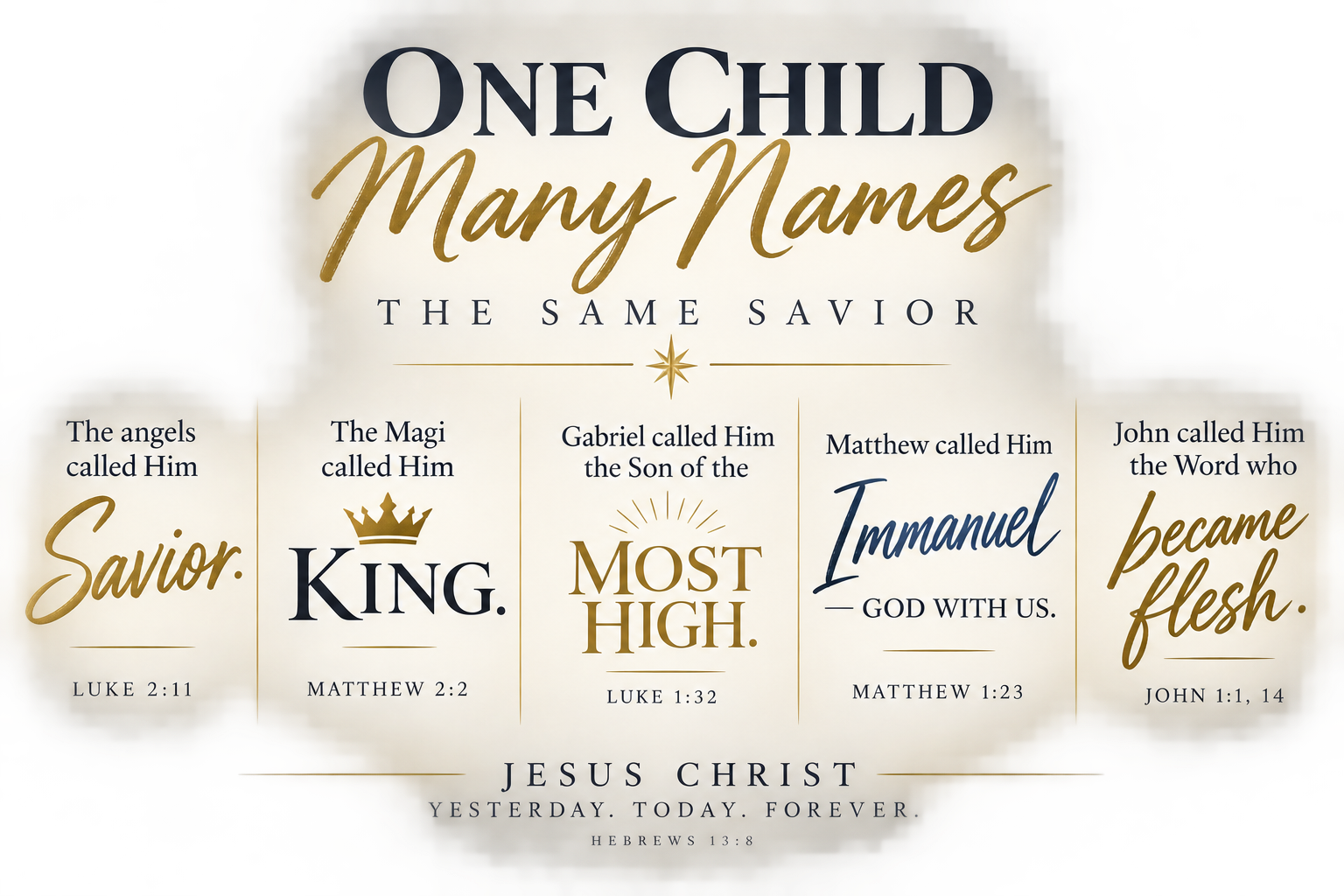
  • The angels called Him Savior.
  • The Magi called Him King.
  • Gabriel called Him the Son of the Most High.
  • Matthew called Him Immanuel — God with us.
  • John called Him the Word who became flesh.

And Jesus would eventually ask His own disciples the question every person must consider:

“Who do you say I am?”

One Child, Many Names, The Same Savior

From Bethlehem to the Cross—and the Empty Tomb

The birth of Jesus is not the end of the story. It is the beginning.

  1. The child born in Bethlehem grew into a man.
  2. Jesus taught with authority.
  3. He healed the sick.
  4. He welcomed sinners.
  5. He confronted hypocrisy.
  6. He claimed a unique relationship with God.
  7. He was crucified under Pontius Pilate.
  8. And His followers proclaimed that on the third day: He rose from the dead.

If you want to understand why Christians believe the baby born in Bethlehem truly is the Son of God, continue with Who Is Jesus? And if you are wondering what Jesus’ life, death and resurrection mean for you personally, read What Is Salvation?

Because the greatest message of the birth of Jesus is not simply that a child was born long ago. It is that:

God loved us enough to come to us.

“The Word became flesh and made his dwelling among us.” — John 1:14

Jesus Christ came into the world—and He came to save.