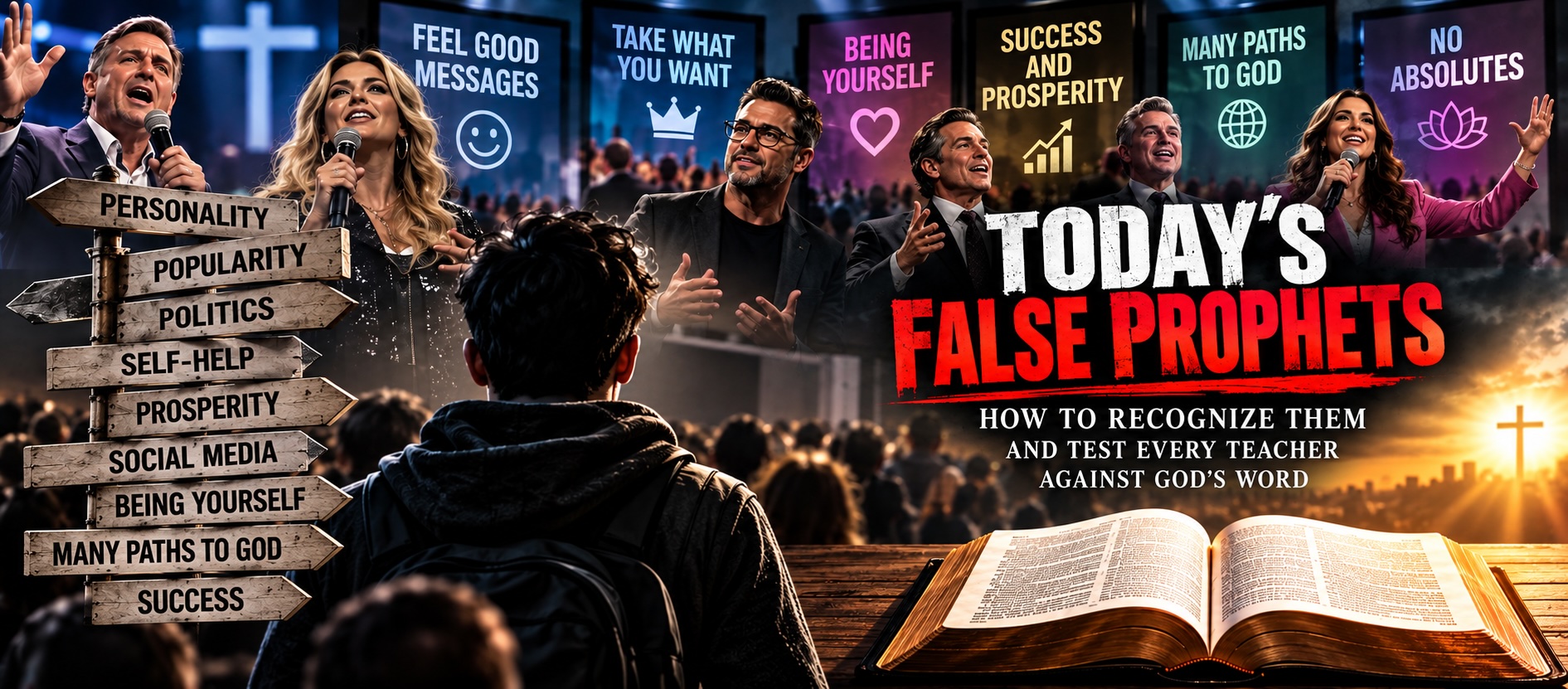
How To Recognize False Prophets: Test Every Teacher Against God’s Word
False prophets are not just something Christians needed to worry about thousands of years ago. They are still here.
They may stand behind pulpits, carry religious titles, teach Bible studies, write books, host podcasts, post videos on social media or gather enormous online followings. Some may sound compassionate, intelligent and convincing. Some may even talk frequently about Jesus. That does not automatically mean what they are teaching comes from God.
The Bible never tells Christians to blindly trust someone simply because that person calls themselves a pastor, minister, reverend, prophet or Christian teacher. Instead, God tells us to test what we hear.
John gives Christians one of the clearest warnings in the Bible:
“Dear friends, do not believe every spirit, but test the spirits to see whether they are from God, because many false prophets have gone out into the world.” — 1 John 4:1
Notice that John doesn’t say a few false prophets might eventually appear. He says many false prophets have gone out into the world. And his warning is just as important today.
What Does 1 John 4 Say About False Prophets?
John doesn’t merely tell us false teachers exist. He tells us one of the most important ways to recognize them: look carefully at what they teach about Jesus Christ.
1 John 4:2–3 says:
“Every spirit that acknowledges that Jesus Christ has come in the flesh is from God, but every spirit that does not acknowledge Jesus is not from God.” – 1 John 4:2-3
John was confronting false teachings about the identity and nature of Jesus. His point remains extremely important.
What someone believes and teaches about Jesus matters. Jesus isn’t an optional part of Christianity.
You cannot remove His identity, change His nature, dismiss His birth, eliminate His death for our sins, deny His resurrection and then simply replace those truths with a version of Jesus that feels more comfortable.
At some point, we are no longer following the Jesus revealed in Scripture. We have created a different Jesus.
A Modern Example of a False Teacher: When a Christian Teacher Questions Whether Jesus Even Existed
This subject became very personal to me recently after I watched a video involving Rev. Babs Miller, identified by St. Andrew’s Presbyterian Church in Austin, Texas, as its Minister to the Parish.
In the recorded conversation, Miller reportedly said: “We have no way of knowing if Jesus really existed.”
She also rejected the virgin birth and reportedly said that whether Jesus actually existed did not matter to her. She described an approach to religion similar to a 12-step program: “Take what you want and leave the rest.”
She also stated that Jesus did not die to save us from our sins. I don’t bring this up because Christians should spend their time attacking individual people. I bring it up because this is exactly why Christians need to understand 1 John 4.
Source note: I encourage readers to listen to the original conversation for themselves and compare what is said with Scripture. My purpose in referencing it is not to attack an individual, but to demonstrate why Christians should test every teaching against God’s Word. Listen to the original conversation
When someone teaching within a Christian church questions the existence of Jesus, rejects His virgin birth and rejects His sacrificial death for our sins, Christians shouldn’t ask: Does this person have a religious title?
We should ask: What does Scripture say? And then we compare the teaching with God’s Word.
1. Did Jesus Really Exist?
The New Testament doesn’t present Jesus as a fictional character or merely as a collection of inspiring ideas. It repeatedly presents people who claimed to have seen Him, heard Him, walked with Him and witnessed what happened.
Peter wrote:
“For we did not follow cleverly devised stories when we told you about the coming of our Lord Jesus Christ in power, but we were eyewitnesses of his majesty.” — 2 Peter 1:16
Luke explains at the beginning of his Gospel that the events he recorded had been handed down by eyewitnesses, and that he had carefully investigated them in order to provide an orderly account.
“Many have undertaken to draw up an account of the things that have been fulfilled among us, 2 just as they were handed down to us by those who from the first were eyewitnesses and servants of the word. 3 With this in mind, since I myself have carefully investigated everything from the beginning, I too decided to write an orderly account for you, most excellent Theophilus…” – Luke 1-3
John similarly identifies John the Baptist as a witness.
“There came a man who was sent from God; his name was John. He came as a witness to testify concerning that light, so that through him al men might believe” – John 1:6-7
John also says:
“That which was from the beginning, which we have heard, which we have seen with our eyes, which we have looked at and our hands have touched—this we proclaim concerning the Word of life.” – 1 John 1:1
Paul records that after the resurrection Jesus appeared to Peter, the Twelve, James, the apostles and more than 500 people at one time.
“3 For what I received I passed on to you as of first importance: that Christ died for our sins according to the Scriptures, 4 that he was buried, that he was raised on the third day according to the Scriptures, 5 and that he appeared to Peter, and then to the Twelve. 6 After that, he appeared to more than five hundred of the brothers and sisters at the same time, most of whom are still living, though some have fallen asleep. 7 Then he appeared to James, then to all the apostles,8 and last of all he appeared to me also, as to one abnormally born.” – 1 Corinthians 15:3-8
These are not presented by the New Testament writers as symbolic stories. They are presented as testimony about events they believed actually happened. There are also ancient references to Jesus outside the New Testament, including references associated with the Jewish historian Josephus and the Roman historian Tacitus.
Christians certainly believe more about Jesus than a secular historian is able to establish historically. Faith includes truths such as His divinity, miracles and resurrection. But saying that we simply have “no way of knowing if Jesus really existed” goes much further than questioning a particular miracle.
Christianity is built around a real Jesus who entered human history.
If Jesus never existed, Christianity doesn’t merely need a small adjustment. Its foundation collapses.
2. What About the Virgin Birth?
The virgin birth isn’t an insignificant Christmas detail that Christians can simply remove because it sounds impossible. Matthew explicitly records that Mary became pregnant through the Holy Spirit before she and Joseph came together.
“This is how the birth of Jesus the Messiah came about: His mother Mary was pledged to be married to Joseph, but before they came together, she was found to be pregnant through the Holy Spirit.” – Matthew 1:18
Luke records Mary’s own question:
“How will this be…since I am a virgin?” – Luke 1:34
The angel responds that the Holy Spirit would come upon her and that the child would be called the Son of God.
“The angel answered, “The Holy Spirit will come on you, and the power of the Most High will overshadow you. So the holy one to be born will be called[a] the Son of God.” – Luke 1:35
Read What Scripture Actually Says—Don’t Add to the Conversation
This is another example of why Christians need to open the Bible and examine what they hear for themselves.
In a July 2025 appearance on The Joe Rogan Experience, Texas politician and seminary student James Talarico discussed Mary and the birth of Jesus as well as the Ten Commandments and other topics. (Listen or watch the original conversation here). While making an argument about abortion, Talarico said:
“God asks for Mary’s consent.” He then told listeners to go back and read Luke, saying that Gabriel “asks Mary if this is something she wants to do.”
But when we actually go back and read Luke 1:26–38, Gabriel never asks Mary that question.
Look carefully at the conversation. Gabriel tells Mary that she has found favor with God and announces:
“You will conceive and give birth to a son, and you are to call him Jesus.” — Luke 1:31
Mary does ask Gabriel a question—but her question is not whether she wants this to happen. She asks:
“How will this be…since I am a virgin?” — Luke 1:34
Gabriel then explains that the Holy Spirit will come upon her and that the child will be called the Son of God. Mary’s response is beautiful and important:
“I am the Lord’s servant…May your word to me be fulfilled.” — Luke 1:38
Notice the difference.
- What Talarico described: Gabriel asks Mary whether this is something she wants to do, and Mary gives her consent.
- What Luke records: Gabriel announces what God is going to do. Mary asks how this can happen because she is a virgin. Gabriel explains how it will happen, and Mary responds in faithful submission to God.
Mary absolutely responds willingly. Nothing in the passage portrays her fighting against God or being unwilling to serve Him. Her response demonstrates remarkable faith, humility and obedience. But that is different from saying that Scripture records Gabriel asking for her permission before God could act. It doesn’t. And this is exactly why biblical discernment matters.
Someone can say, “Go back and read this in Luke,” and still describe something that the text itself does not actually say.
So go back and read it. Don’t take my word for it either. Open Luke 1:26–38 and look for the question:
“Mary, is this something you want to do?” It isn’t there.
Look for Gabriel asking Mary’s permission. It isn’t there.
Look at Mary’s actual question. “How will this be…since I am a virgin?”
This is an important lesson that reaches far beyond one interview or one person.
Don’t Confuse an Interpretation With Scripture
Pastors, politicians, teachers, Christian influencers—and even people writing Christian websites—can offer interpretations of Scripture. But an interpretation should never quietly become words that Scripture never says.
There is an important difference between saying:
“I interpret Mary’s response as demonstrating willing acceptance.”
and saying:
“The angel asks Mary if this is something she wants to do.”
The first is an interpretation someone can examine and discuss. The second describes a conversation that Luke does not record. That is why context matters so much.
When someone tells you “the Bible says…”, don’t stop there.
- Ask: Where?
- Read the passage yourself.
- Read what comes before it.
- Read what comes after it.
Ask whether the speaker is explaining what Scripture actually says—or inserting an idea into the passage that isn’t there. This is exactly the kind of discernment John calls Christians to practice when he says:
“Do not believe every spirit, but test the spirits to see whether they are from God.” — 1 John 4:1
Testing a teaching doesn’t mean attacking the person who said it. It means taking their words and placing them beside God’s Word. And when the two don’t say the same thing, Christians should know which one carries the authority.
The Christian response to something miraculous shouldn’t automatically be: That doesn’t make sense to me, so I’ll leave that part out.
If God created the universe, the question isn’t whether a virgin birth exceeds ordinary human ability. Of course it does! The question is whether it exceeds God’s ability. Scripture answers that too:
“For no word from God will ever fail.” — Luke 1:37
Christianity contains supernatural claims because Christianity is about a supernatural God.
3. “Take What You Want and Leave the Rest” Is the Opposite of Biblical Discipleship
This may be one of the most dangerous ideas confronting Christianity today.
Take what makes sense.
Keep what you like.
Leave what you don’t.
It sounds freeing. But who becomes the final authority under that system? We do.
Instead of allowing Scripture to correct us, we begin correcting Scripture. Instead of asking God to change our thinking, we change God’s Word until it agrees with our thinking.
Eventually everyone can create a personalized Christianity:
- I like Jesus talking about love, but not judgment.
- I like forgiveness, but not repentance.
- I like heaven, but not hell.
- I like grace, but not obedience.
- I like Jesus as a teacher, but not Jesus as Lord.
- I like His example, but not His cross.
- I like His compassion, but not His commands.
That isn’t submitting ourselves to God. That is asking God to submit Himself to us!
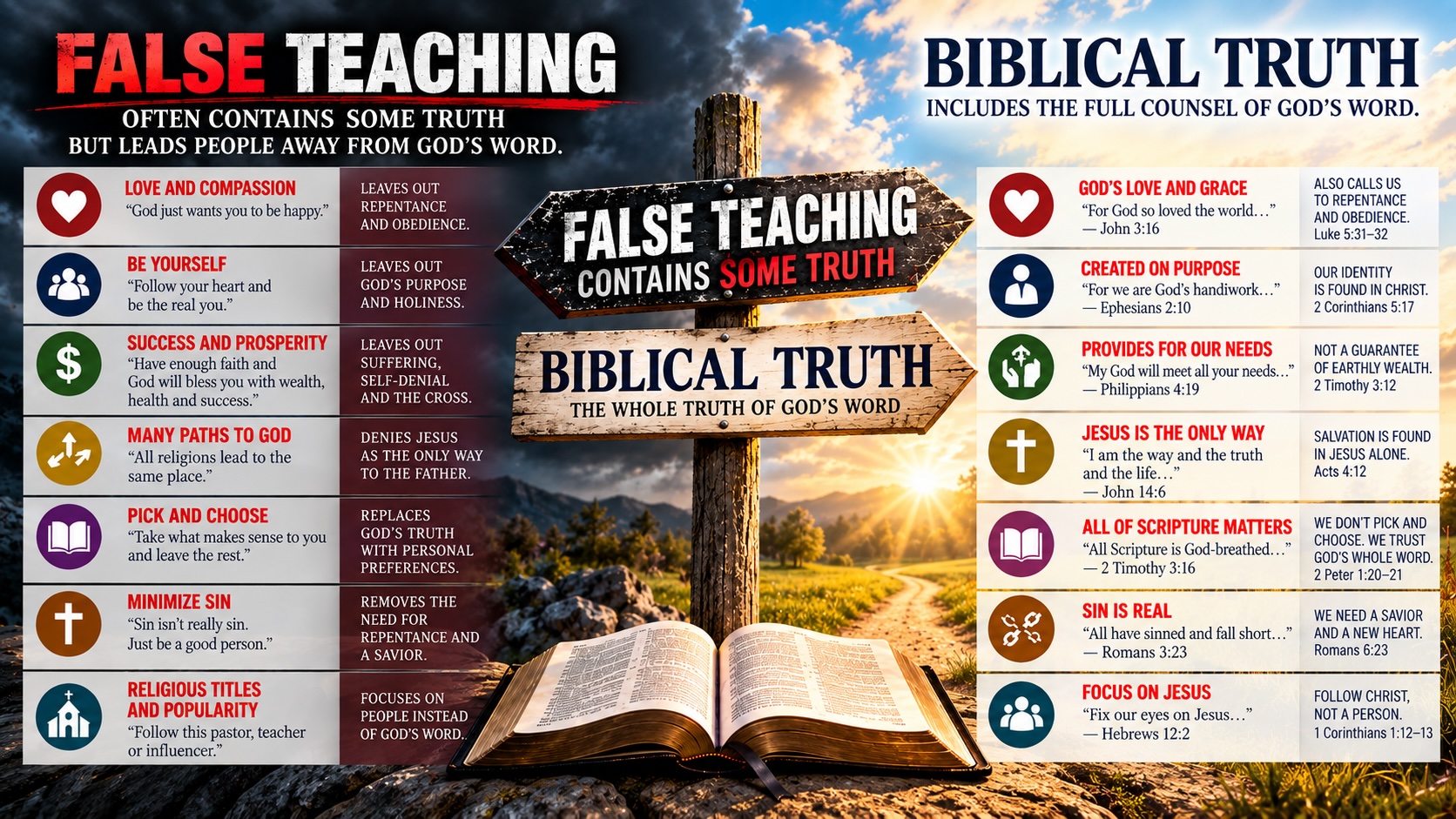
False Teaching Often Contains Some Truth
This is what can make false teaching difficult to recognize. A false teacher doesn’t necessarily stand up and announce, “Everything I’m about to tell you is false.”
- There may be truth mixed with error
- They may talk about love
- Justice
- Compassion
- Forgiveness
- Helping the poor
- Welcoming people
- Caring for our neighbors
Those things can absolutely be biblical. But biblical-sounding language doesn’t automatically make the entire message biblical. A teacher can say many true things and still seriously distort who Jesus is. That is why Christians must know Scripture for themselves.
How Do You Test a Pastor, Teacher or Christian Influencer?
- You don’t test teachers by asking whether you like them.
- You don’t test them by their follower count.
- You don’t test them by how large their church is.
- You don’t test them by whether they have “Reverend,” “Pastor,” “Doctor,” “Prophet” or another title before their name.
- And you don’t test them by whether their message makes you feel good.
You test what they teach against God’s Word.
Here are some important questions every Christian should learn to ask:
- What do they teach about Jesus?
Do they acknowledge the biblical Jesus—the Son of God who came in the flesh, died for our sins and rose again? - Do they treat Scripture as authority?
Or do they accept the portions they like while dismissing passages that conflict with their personal beliefs? - Do they change Scripture to fit the culture?
God’s Word can challenge every culture, including ours. - Do they preach repentance as well as love and grace?
Jesus showed extraordinary compassion, but He also called people to repentance. - Does their teaching point people toward Jesus or toward themselves?
Christianity is not supposed to revolve around the personality of a pastor, teacher or influencer. - Do they take verses in context?
A Bible verse can be quoted accurately and still be used incorrectly when removed from its context. - What kind of fruit does the teaching produce?
Jesus warned about false prophets and said, “By their fruit you will recognize them.” - Are you allowed to question their teaching?
A faithful teacher should not be threatened when Christians open their Bibles and examine what is being taught.
Don’t Just Test the Teachers You Disagree With
This is important! Biblical discernment isn’t supposed to become a weapon we use only against people we already dislike.
Test everyone:
- Test your favorite pastor.
- Test the preacher your parents listened to.
- Test the bestselling Christian author.
- Test the person with millions of followers.
- Test the viral TikTok preacher.
- Test the teacher whose politics match yours.
- Test the teacher whose politics don’t.
- Test what you hear on Christian television.
- And test what I write on this website.
Don’t believe something merely because I wrote it here.
- Open your Bible.
- Read the chapter.
- Look at the verses before and after it.
- Pray.
- Study.
- Ask questions.
That is not weak faith. That is biblical discernment.
The Bereans Checked What Paul Taught
Acts 17 gives us a remarkable example:
“Now the Berean Jews were of more noble character than those in Thessalonica, for they received the message with great eagerness and examined the Scriptures every day to see if what Paul said was true.” Acts 17:11
Paul was an apostle, yet the Bereans examined the Scriptures to determine whether what they were being taught was true. They weren’t condemned for checking Paul’s teaching. They were commended. Think about that.
If people were encouraged to examine the teaching of Paul, we certainly shouldn’t be afraid to examine the teaching of a pastor in 2026. No Christian leader should become more authoritative in our lives than God’s Word.
Jesus Himself Warned Us About False Prophets
The warning didn’t begin with John.
Jesus said:
“Watch out for false prophets. They come to you in sheep’s clothing, but inwardly they are ferocious wolves.” — Matthew 7:15
The imagery matters. A wolf in sheep’s clothing doesn’t look dangerous at first. That is the point:
- False teaching can be attractive.
- It can sound loving.
- It can sound intellectual.
- It can sound modern.
- It can sound tolerant.
- It can sound spiritual.
- It may even use Christian terminology.
The question is never simply how does it sound? The question is: Is it true?
Paul Warned About Teachers Who Tell People What They Want to Hear
Paul gave Timothy another warning that sounds remarkably relevant today.
“Some have departed from these and have turned to meaningless talk. They want to be teachers of the law, but they do not know what they are talking about or what they so confidently affirm.” – 1 Timothy 1:6-7
He warned that a time would come when people would not tolerate sound doctrine. Instead, they would gather teachers who would tell them what their “itching ears” wanted to hear.
“For the time will come when people will not put up with sound doctrine. Instead, to suit their own desires, they will gather around them a great number of teachers to say what their itching ears want to hear.” – 2 Timothy 4:3
That warning reveals something uncomfortable. False teachers aren’t the only problem. Sometimes we want false teaching:
- We may want someone to tell us that our sin isn’t really sin.
- That repentance isn’t necessary.
- That obedience doesn’t matter.
- That every path eventually reaches God.
- That Jesus is merely one spiritual teacher among many.
- That Scripture can be ignored whenever it becomes uncomfortable.
A teacher willing to tell people exactly what they want to hear will rarely have difficulty finding an audience.
Other False Teachings Christians Should Watch For
Modern false teaching takes many forms:
- Some teachers preach a prosperity message suggesting that enough faith should produce wealth, health and success.
- Others minimize sin until repentance becomes unnecessary.
- Some teach that Jesus is simply one of many paths to God rather than taking seriously His claim in John 14:6.
- Some deny Christ’s bodily resurrection.
- Some reject His divinity.
- Some deny His humanity.
- Some eliminate the cross as the sacrifice for our sins.
- Others turn Christianity primarily into politics, self-improvement, social activism, personal success or motivational speaking.
- And some gradually redefine Christianity until almost everything remains except Christ.
Different errors require different biblical responses, but the principle remains the same: Test the teaching.
Loving Someone Doesn’t Mean Accepting Everything They Teach
Christians sometimes become afraid to identify false teaching because they don’t want to appear judgmental or hateful. But biblical love and biblical truth aren’t enemies.
We can treat people with dignity while firmly saying: “That teaching contradicts Scripture.”
Jesus was full of grace and truth. Christians should never delight in humiliating someone who is wrong. Our purpose should be protecting truth, helping people recognize error and pointing people toward Christ.
The goal isn’t winning an argument. The goal is knowing the truth.
Know Your Bible So Well That Counterfeits Become Easier to Recognize
One of the best protections against false teaching is not obsessively studying every false teacher. It is knowing the truth.
Read Scripture yourself and:
- Don’t let Sunday morning be the only time your Bible opens.
- Don’t build your theology from thirty-second social-media clips.
- Don’t assume a viral Christian quote actually came from Scripture.
- Don’t assume someone speaks for God because they have a microphone and a religious title.
- And don’t outsource your relationship with God to your pastor. A good pastor should help you understand Scripture—not replace your need to read it.
The more familiar you become with God’s Word, the easier it becomes to recognize when something doesn’t line up.
False Prophets Are Not New—But Social Media Gives Them a Bigger Microphone
False teaching existed long before the internet. What has changed is its reach. A person once needed a church, television program or publishing deal to reach thousands of people.
Today anyone can upload a sixty-second video and potentially reach millions. And algorithms don’t determine whether theology is true. They determine whether people keep watching.
Controversial, emotional and reassuring messages can spread incredibly quickly. That makes John’s instruction even more important today: “Test the spirits.”
- Don’t confuse popularity with truth.
- Don’t confuse confidence with authority.
- Don’t confuse compassion with correct doctrine.
- Don’t confuse a religious title with biblical faithfulness.
- And don’t confuse something going viral with something coming from God.
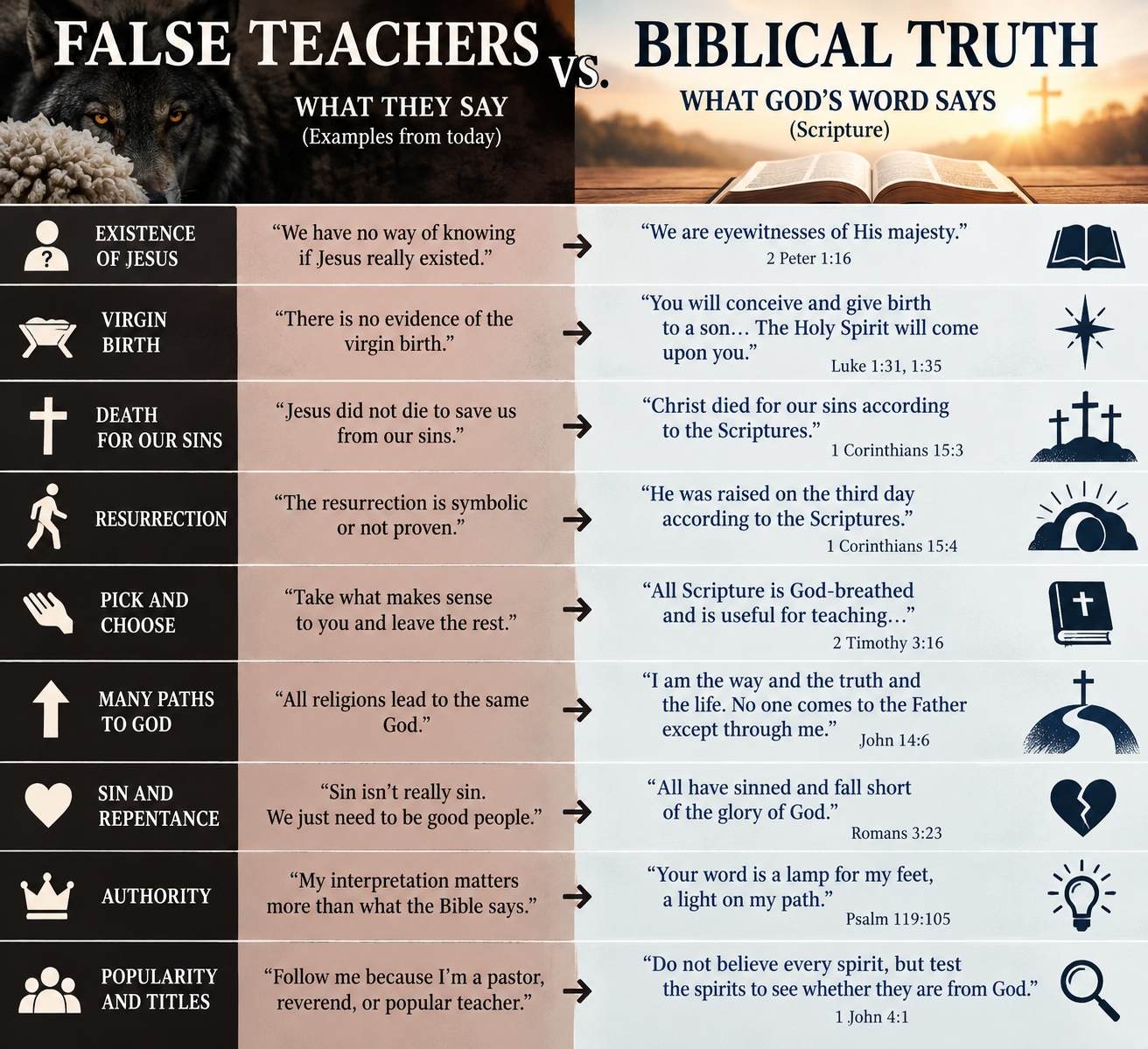
You Don’t Get to Rewrite Jesus
This may be the simplest way I can explain why this matters so deeply to me.
Christianity isn’t about creating the Jesus we would prefer. It’s about following the Jesus who is.
The Jesus revealed in Scripture sometimes comforts us. Sometimes He challenges us. Sometimes His words are easy to receive. Sometimes they confront something in us that needs to change. But if I only accept the teachings of Jesus that agree with me, I’m not really following Jesus. I’m following myself.
Jesus doesn’t need me to edit Him. God’s Word doesn’t need me to modernize its truth. And Christianity doesn’t become more authentic when we remove everything supernatural, difficult or culturally unpopular from it.
Test What I Say Too!
I want to end this personally. This website exists because I want people to know Jesus—especially people who don’t know Him yet, have questions about Him, have been hurt by religion or simply don’t know what to believe.
That makes this subject extremely important to me. I don’t want you blindly following a pastor. I don’t want you blindly following a Christian influencer. And I certainly don’t want you blindly following me.
If something I write doesn’t line up with God’s Word, go with God’s Word. Every time.
My responsibility is not to make Scripture agree with me. My responsibility is to make sure I am willing to be corrected by Scripture.
That is why John’s warning matters so much: Do not believe every spirit. Test them.
Because many false prophets have gone out into the world. And the safest place for Christians isn’t blindly following another human being. It is knowing Jesus, knowing His Word and learning to recognize the difference between the spirit of truth and the spirit of falsehood.
Frequently Asked Questions About False Prophets
A false prophet or false teacher claims spiritual authority or teaches spiritual truth while leading people away from what God has revealed. Scripture repeatedly warns believers not to accept religious claims simply because someone says they come from God.
1 John 4:1 tells Christians to “test the spirits” and places particular emphasis on what a teacher confesses about Jesus Christ. A person’s teaching about the identity and nature of Jesus is therefore an essential part of biblical discernment.
Christians should respectfully examine every teaching against Scripture. Acts 17:10-12 describes the Bereans examining the Scriptures to see whether Paul’s message was true. Biblical accountability isn’t disrespect; it is discernment.
No. Titles such as pastor, minister, reverend, priest, teacher or prophet don’t guarantee that someone’s teaching agrees with Scripture. Jesus and the apostles repeatedly warned that false teachers would arise.
Yes. Error can be especially difficult to recognize when mixed with truth. Christians should evaluate the whole teaching in context rather than assuming everything someone teaches is correct because some of it is biblical.
First, read the relevant Scripture carefully and in context. Make sure you have understood both the Bible and the pastor correctly. Ask respectful questions when appropriate. If a teacher consistently rejects or contradicts foundational Christian teaching, don’t ignore it simply because you like the person or the church.
Know Scripture personally. Pray for wisdom. Read passages in context. Compare teachings with the whole counsel of Scripture rather than isolated verses. Most importantly, keep Jesus—not a pastor, denomination, influencer or political movement—at the center of your faith.