
Experiencing God’s Love: How to Know His Love Is Real
Have you ever wondered, “Does God really love me?”
Maybe you believe God loves other people, but you struggle to believe He could love you. Perhaps you feel too broken, too ashamed, too angry, or too far from Him. You may have prayed and heard nothing, faced a painful loss, or waited so long for an answer that God now seems distant.
Here is the truth: God’s love is not based on how lovable you feel. It is based on who God is.
The Bible does not merely say that God shows love. It tells us that God is love. His love is part of His character. It is faithful, sacrificial, patient, and greater than anything you have done or anything that has been done to you.
“God is love. Whoever lives in love lives in God, and God in them.” — 1 John 4:16 NIV
Experiencing God’s love begins with knowing that His love is already reaching toward you—even if your emotions have not caught up with that truth yet.
What Does It Mean to Experience God’s Love?
To experience God’s love means more than knowing Bible verses about love. It means learning to trust that God knows you completely, desires a relationship with you, forgives you through Jesus Christ, remains present in your suffering, and changes how you see yourself and others.
Sometimes His love brings comfort. At other times, it brings correction, healing, courage, conviction, or the strength to keep going.
God’s love is not always experienced as a strong emotion. You may not feel overwhelmed, excited, or peaceful every time you pray. Faith is not measured by the intensity of your feelings. It rests on the truth of God’s character and what He has done through Jesus.
How Do We Know God Loves Us?
The clearest evidence of God’s love is Jesus Christ.
God did not wait for humanity to become worthy of His love. He sent His Son into a broken world to rescue people who could never save themselves.
“For God so loved the world that he gave his one and only Son, that whoever believes in him shall not perish but have eternal live.” — John 3:16 NIV
God’s love is not distant, passive, or merely sentimental. It took action.
Jesus entered our suffering, experienced rejection, carried our sin, died on the cross, and rose from the dead. Through Him, we can be forgiven and brought into a relationship with God.
Romans 5:8 explains that God demonstrated His love for us while we were still sinners. The cross does not show us that we finally became good enough for God. It shows us how deeply God loved us when we could not make ourselves right with Him.
You can read more about this on the pages Who Is Jesus? and What Is Salvation?.
God’s Love Is Agape Love
The New Testament frequently uses the Greek word agapē when speaking about God’s love. Agape describes a committed, self-giving love that seeks the good of another person.
Unlike a love based only on attraction, emotion, or what someone can give us in return, agape love chooses to act faithfully and sacrificially.
This does not mean God approves of everything we do. Love and approval are not the same. Because God loves us, He calls us away from sin and toward the life He created us to live.
God’s correction is not proof that He has rejected us. Just as a loving parent guides a child away from danger, God’s instruction is meant to lead us toward truth, freedom, and life.
Does God Love Me Even When I Sin?
Yes. Your sin does not make God stop loving you.
However, sin can damage your relationship with God and affect your ability to recognize His presence. Guilt may cause you to hide from Him. Shame may tell you that you are no longer welcome. Pride may keep you from admitting that you need forgiveness.
But God does not ask you to clean yourself up before coming to Him. He asks you to come honestly.
“If we confess our sins, he is faithful and just and will forgive us our sins and purify us from all unrighteousness.” — 1 John 1:9
Confession is not informing God of something He does not already know. It is agreeing with Him about our sin and trusting His mercy.
The difference between conviction and condemnation is important:
- Conviction points to what is wrong and leads us back to God.
- Condemnation says we are hopeless and should stay away from God.
Romans 8:1 says there is no condemnation for those who are in Christ Jesus. God’s love does not ignore sin, but it offers forgiveness, restoration, and a new beginning through Jesus.
Why Can’t I Feel God’s Love?
There are many reasons someone may struggle to feel loved by God. You may be experiencing:
- grief
- depression
- exhaustion
- trauma
- unanswered prayer
- loneliness
- disappointment
- or you may have been hurt by a parent, church, spouse, friend, or another person who claimed to represent God.
Those experiences can influence the way you view Him.
If human love has been unreliable, controlling, or conditional, it may be difficult to trust a God you cannot physically see. But people’s failures do not define God’s character. God is not an enlarged version of the people who hurt you.
Not feeling God’s love does not mean He has abandoned you.
Even Jesus cried out in anguish on the cross. The Psalms are filled with honest questions from people who loved God but sometimes felt forgotten. Biblical faith makes room for sorrow, doubt, and difficult questions.
You can tell God exactly how you feel. You do not have to pretend. Honest prayer is not disrespectful; it is part of a real relationship.

Let God Do His Work in Your Life
God often works through the people and circumstances He brings into our lives. He may send someone to encourage us, teach us, pray for us, or help us recognize a truth we could not see on our own. He may also reveal that certain relationships, habits, or influences are harming us and keeping us from growing closer to Him.
This does not mean every person who challenges us should be removed from our lives. Sometimes God uses difficult people and situations to develop patience, wisdom, courage, and stronger faith. However, there are also times when healthy boundaries are necessary—especially when a relationship is abusive, manipulative, destructive, or continually pulling us away from God.
God created us for fellowship with Him and with one another. We need people who will encourage our faith, speak truth with love, pray with us, and help us become who God created us to be. As we allow God to work within us, He can also use us to encourage, comfort, and serve others.
“For it is God who works in you to will and to act in order to fulfill his good purpose.” — Philippians 2:13
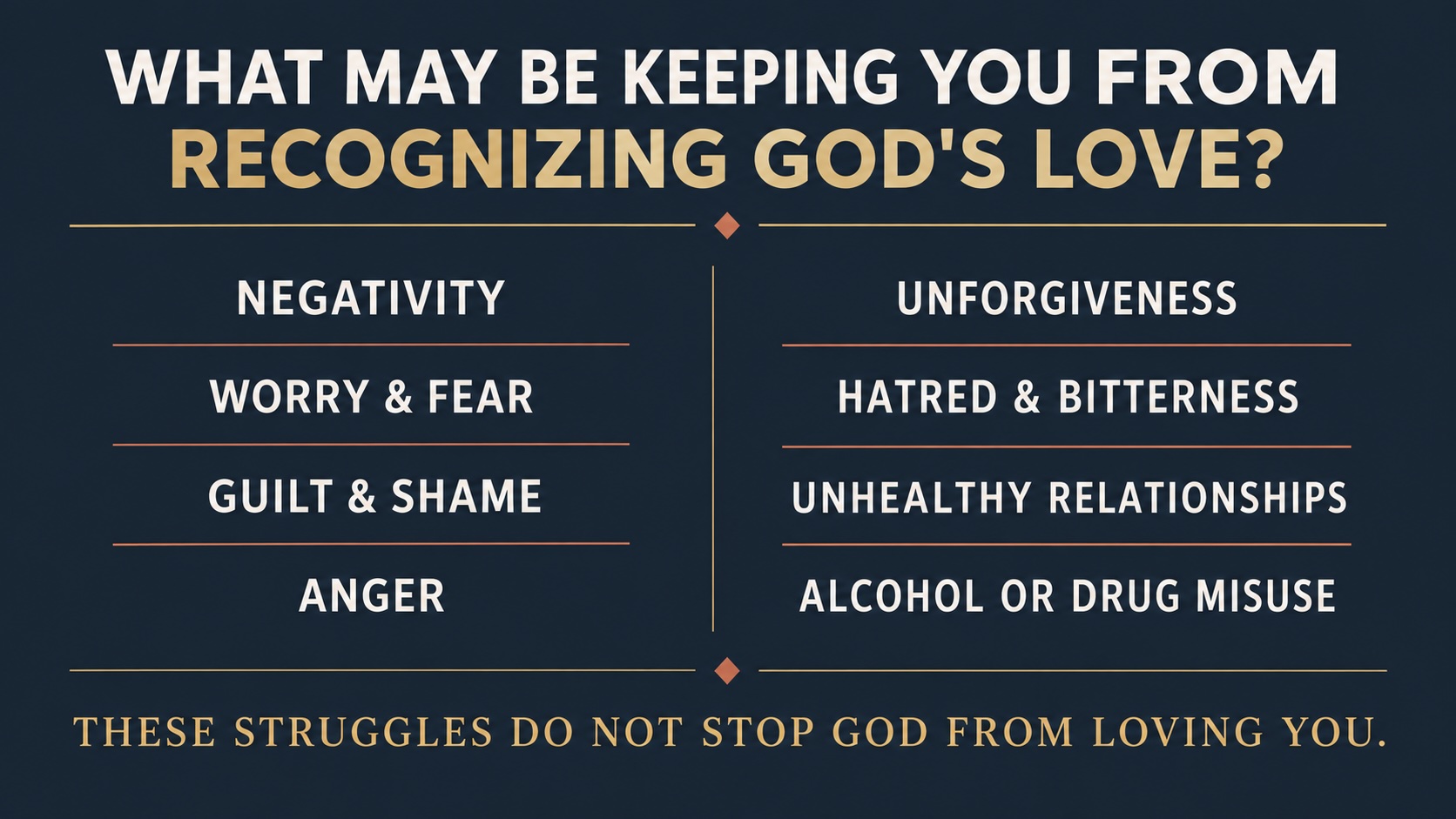
What May Be Keeping You from Recognizing God’s Love?
Nothing you are facing can make God stop loving you. However, certain thoughts, emotions, relationships, and habits can make it harder for you to recognize His love, trust Him, or live in the freedom He offers.
These may include:
- Constant negativity
- Worry and fear
- Unresolved guilt or shame
- Uncontrolled anger
- Unforgiveness
- Hatred and bitterness
- Destructive or unhealthy relationships
- Alcohol or drug misuse
- Any habit that begins controlling your thoughts and decisions
These struggles do not place you beyond God’s love. In fact, they are reasons to draw closer to Him. God wants you to bring your fear, anger, guilt, pain, and addictions into the light so He can begin healing and changing you.
Some struggles may also require help from other people. Asking a pastor, counselor, doctor, recovery group, or trusted Christian friend for support is not a failure of faith. God frequently works through people who are equipped to help us.
Romans 8:5–8 contrasts a mind controlled by our sinful nature with a mind directed by the Holy Spirit. This passage reminds us that what controls our minds affects how we live. When we surrender our thoughts and choices to God, the Holy Spirit begins leading us toward life and peace.
Take One Small Step Toward God
You do not have to change everything in one day. If opening your heart to God feels unfamiliar or uncomfortable, begin with one small step. Ask God to show you what needs to change and to help you recognize the ways He is already working in your life.
Your first step might be to:
- Pray honestly about what is weighing you down.
- Surround yourself with encouraging, godly people.
- Find a Bible-based church.
- Join a Bible study or small group.
- Tell someone you love and appreciate them.
- Begin the process of forgiving someone.
- Apologize to someone you have hurt.
- Do something kind for a family member.
- Call someone who may be lonely.
- Encourage a person who is struggling.
- Smile at or speak kindly to a stranger.
- Ask for help with an unhealthy habit or addiction.
You do not earn God’s love by doing these things. These are simply ways to open your life to His direction and allow His love to flow through you.
God’s work in you may begin quietly. It may start with one honest prayer, one surrendered habit, one healthy boundary, or one act of love. Take the first step and trust Him with what comes next.
God’s Love in Pain and Unanswered Prayer
Pain can make God seem distant. We may think, “If God loves me, why did He allow this?”
The Bible does not promise that God’s people will avoid suffering. It promises that suffering will not have the final word and that nothing can separate those who belong to Christ from His love.
Romans 8:38–39 names death, life, spiritual powers, the present, the future, and all creation—and says none of them can separate us from God’s love in Christ.
God’s love does not always remove a painful situation immediately. Sometimes it appears as strength for one more day, peace that makes no sense, a person who arrives at the right moment, or hope that survives when circumstances have not changed.
We may not receive every explanation we want. But the cross assures us that God is not indifferent to human suffering. Jesus entered it Himself.
How Can I Begin Experiencing God’s Love?
You cannot earn God’s love, but you can become more aware of it and learn to live in it.
1. Come to God honestly
Tell Him what you believe, what you doubt, what hurts, and what frightens you. God already knows your thoughts. Prayer allows you to bring those thoughts into your relationship with Him.
A simple prayer might begin:
“God, I want to know You, but I struggle to believe You love me. Please help me understand Your love and see Your presence in my life.”
2. Look at Jesus
When you question God’s love, return to the life, death, and resurrection of Jesus. Jesus shows us what God is like. He welcomed rejected people, showed compassion to the suffering, forgave sinners, confronted hypocrisy, and gave His life for others.
3. Read what Scripture says about God’s love
Feelings change quickly, but God’s Word gives you something steady to return to. Begin with:
- John 3:16–17
- Romans 5:5–8
- Romans 8:31–39
- Psalm 139
- Zephaniah 3:17
- Luke 15:11–32
- 1 Corinthians 13:4–8
- Ephesians 3:16–19
- 1 John 4:7–19
Read slowly. Ask what each passage reveals about God, His character, and His actions
4. Accept His forgiveness
You may understand forgiveness intellectually while continuing to punish yourself emotionally. If you have confessed your sin and placed your faith in Jesus, you do not need to keep trying to pay for what Christ has already carried.
Grace can be difficult to accept because it cannot be earned. That is precisely what makes it grace.
5. Notice the ordinary ways God provides
Not every experience of God’s love will be dramatic. His care may be visible in a needed conversation, daily provision, a timely Scripture, the beauty of creation, strength during hardship, or the faithful presence of another person.
Consider keeping a journal of moments when you recognize God’s provision, comfort, correction, or guidance.
6. Spend time with other believers
God often expresses His love through His people. A healthy, Bible-based church can provide encouragement, teaching, prayer, friendship, and opportunities to serve.
Christian community will not be perfect because it is made of imperfect people. But you were never meant to follow Jesus entirely alone.
7. Show God’s love to someone else
God’s love is meant to flow through us.
You might listen to someone who feels forgotten, forgive a person who hurt you, provide a meal, encourage a struggling friend, defend someone being mistreated, or simply treat an overlooked person with dignity.
We do not serve others to make God love us. We serve because His love is changing us.
God’s Love Does Not Depend on Your Performance
Many of us are accustomed to conditional love. We feel valued when we succeed, help others, behave well, look a certain way, or meet someone’s expectations. When we fail, we expect love to disappear.
That mindset can enter our relationship with God. We may believe He loves us more on the days we pray, read the Bible, or make good choices—and less when we struggle.
Spiritual practices matter, but they do not purchase God’s love. They help us know the God who already loves us.
You are not loved because you performed perfectly today. You are loved because God is loving, and His grace is offered through Jesus Christ.

God’s Love Changes How You See Yourself
The world often assigns value according to appearance, success, popularity, productivity, relationships, or possessions. God sees you differently.
You are not merely your worst mistake. You are not what another person called you. You are not the rejection you experienced, the relationship you lost, or the goal you failed to reach.
God knows every part of your story. He knows your strengths, wounds, motives, temptations, fears, and failures—and still invites you to come to Him.
His love does not leave you unchanged. It gives you a new foundation for your identity. As you learn who you are in Christ, you no longer have to depend entirely on the world’s approval to know your worth.

God’s Love Changes How You Love Others
Receiving God’s love should gradually change how we treat people.
1 John 4 teaches that we love because God first loved us. His love teaches us to be patient, truthful, forgiving, generous, and compassionate.
This does not mean allowing people to abuse, manipulate, or continually harm you. Love can require boundaries. Forgiveness does not always mean immediate trust or restored access to your life. Reconciliation requires truth, repentance, and safety.
Genuine love seeks what is right and good. It is neither cruel nor dishonest, and it does not require you to pretend harmful behavior is acceptable.
You Are Invited to Know God’s Love Personally
God’s love is not only an idea to study. It is an invitation to know Him.
If you have never placed your faith in Jesus, you can come to Him today. Salvation is not earned by good deeds or religious performance. It is received by grace through faith in Jesus Christ.
You can speak to God in your own words. Admit that you have sinned, tell Him you believe Jesus died and rose again, ask for forgiveness, and place your life in His hands.
A prayer does not save you because you said every word perfectly. Jesus saves. Prayer is simply how you express your faith and surrender to Him.
If you need help beginning, visit the Salvation Prayer page.
A Simple Prayer to Experience God’s Love
God, I want to know Your love personally. Sometimes I feel distant from You, and sometimes I struggle to believe I am loved. Help me see You clearly and trust what You have said. Forgive my sins, heal the broken places in my heart, and teach me to receive Your grace. Help me recognize Your presence and share Your love with others. Thank You for loving me and for sending Jesus to save me. In Jesus’ name, amen.
Frequently Asked Questions About Experiencing God’s Love
Begin by coming to God honestly, learning about Jesus, reading Scripture, accepting God’s forgiveness, praying, and spending time with mature believers. Remember that God’s love may be experienced through truth, correction, peace, strength, and faithful presence—not only through emotion.
God loves the world and demonstrated that love by sending Jesus Christ. He invites everyone to repent, believe, and receive eternal life through His Son. John 3:16–17 clearly connects God’s love with His desire to save rather than condemn.
Yes. No past sin places you beyond the reach of God’s mercy. Jesus came to save sinners. When you turn to Him with genuine faith and repentance, He offers forgiveness and a new life.
You may feel distant because of grief, exhaustion, disappointment, unconfessed sin, trauma, depression, or unanswered prayer. Feelings of distance do not necessarily mean God has left. Speak honestly with Him, return to Scripture, and seek support from trustworthy believers. If emotional pain is persistent or overwhelming, speaking with a qualified counselor can also be an important step.
Romans 8:38–39 teaches that nothing in all creation can separate believers from the love of God found in Christ Jesus.
God’s love is not earned through perfect behavior. He loved us while we were sinners and sent Jesus to save us. However, receiving salvation involves responding to His grace through repentance and faith. God’s unconditional love should not be confused with unconditional approval of every choice.
Romans 5:5 says God pours His love into believers’ hearts through the Holy Spirit. The Holy Spirit helps believers understand God’s truth, recognize sin, experience His presence, grow spiritually, and increasingly reflect His love.
Continue seeking God without measuring His presence only by emotion. Prayer is an act of trust, even when it feels quiet. God may be working in ways you cannot yet see. Remain honest, stay connected to Scripture, and allow trusted believers to walk beside you.







You must be logged in to post a comment.