
The Beatitudes Explained: What Does It Mean to Be Blessed?
When Jesus began teaching what we now call the Sermon on the Mount, He started with a series of statements that may seem almost opposite to the way the world thinks.
Blessed are the poor in spirit.
Blessed are those who mourn.
Blessed are the meek.
Blessed are those who hunger and thirst for righteousness.
Blessed are the merciful.
Blessed are the pure in heart.
Blessed are the peacemakers.
Blessed are those who are persecuted because of righteousness.
These teachings are known as the Beatitudes, found in Matthew 5:3-12.
But what did Jesus mean? Was He saying that sadness, poverty, persecution and suffering are somehow good things? No. Jesus was showing us something much deeper.
The Beatitudes describe the heart and character of a person who belongs to God. They show us that God’s definition of a blessed life can look very different from the world’s definition of a successful life.
What Are the Beatitudes?
The Beatitudes are the opening teachings of Jesus in the Sermon on the Mount in Matthew 5.
Jesus had seen the crowds, went up on a mountainside and sat down. His disciples came to Him, and He began teaching them. His first words repeatedly began with:
“Blessed are…”
Jesus then described people whom the world might not normally consider blessed: the humble, grieving, meek, merciful, pure-hearted, persecuted and those who desperately desire righteousness.
The Beatitudes aren’t simply a list of rules for earning God’s favor. They reveal what life in God’s Kingdom looks like. They teach us about humility, mercy, righteousness, purity, peace, faithfulness and our dependence upon God.
What Does “Blessed” Mean in the Beatitudes? The Beatitudes Explained.
When we hear the word blessed, we sometimes think about having a comfortable life, financial success, good health or everything going our way. But the word Jesus used carries a much deeper meaning.
The Greek word translated “blessed” in the Beatitudes is makarios (μακάριος). It can convey the sense of being blessed, happy, fortunate or deeply favored. No single English word completely captures everything expressed by makarios.
There is also an important connection to the Hebrew idea expressed by ashrei (אַשְׁרֵי), from a Hebrew root associated with being happy or blessed. We see this kind of expression in the Psalms:
“Blessed is the one…” — Psalm 1:1
The idea is richer than simply saying, “This person feels happy.”
Jesus was not promising that His followers would always feel happy. After all, He immediately said:
“Blessed are those who mourn…” — Matthew 5:4
A person can mourn and still be makarios.
A person can face persecution and still be makarios.
A person can have very little by the world’s standards and still be makarios.
That is because the blessing Jesus describes isn’t determined by our temporary circumstances. It comes from our relationship with God. In the Beatitudes, Jesus is describing people who are truly fortunate in the deepest spiritual sense because they belong to God’s Kingdom and live under His promises.
So when Jesus says:
“Blessed are the poor in spirit…”
we could hear something deeper than simply:
“Happy are the poor in spirit.”
The meaning is closer to:
How deeply blessed and truly fortunate are those who recognize their need for God, because the Kingdom of Heaven belongs to them.
This changes the way we understand every Beatitude that follows. Being blessed by God does not mean we will never experience pain, disappointment, grief or hardship.
- Someone can be hurting and still be blessed.
- Someone can be grieving and still be blessed.
- Someone can be rejected by the world and still be blessed by God.
The Beatitudes teach us that our circumstances do not determine whether we are blessed. Our relationship with God does.
Jesus Teaches The Beatitudes – The Sermon On The Mount
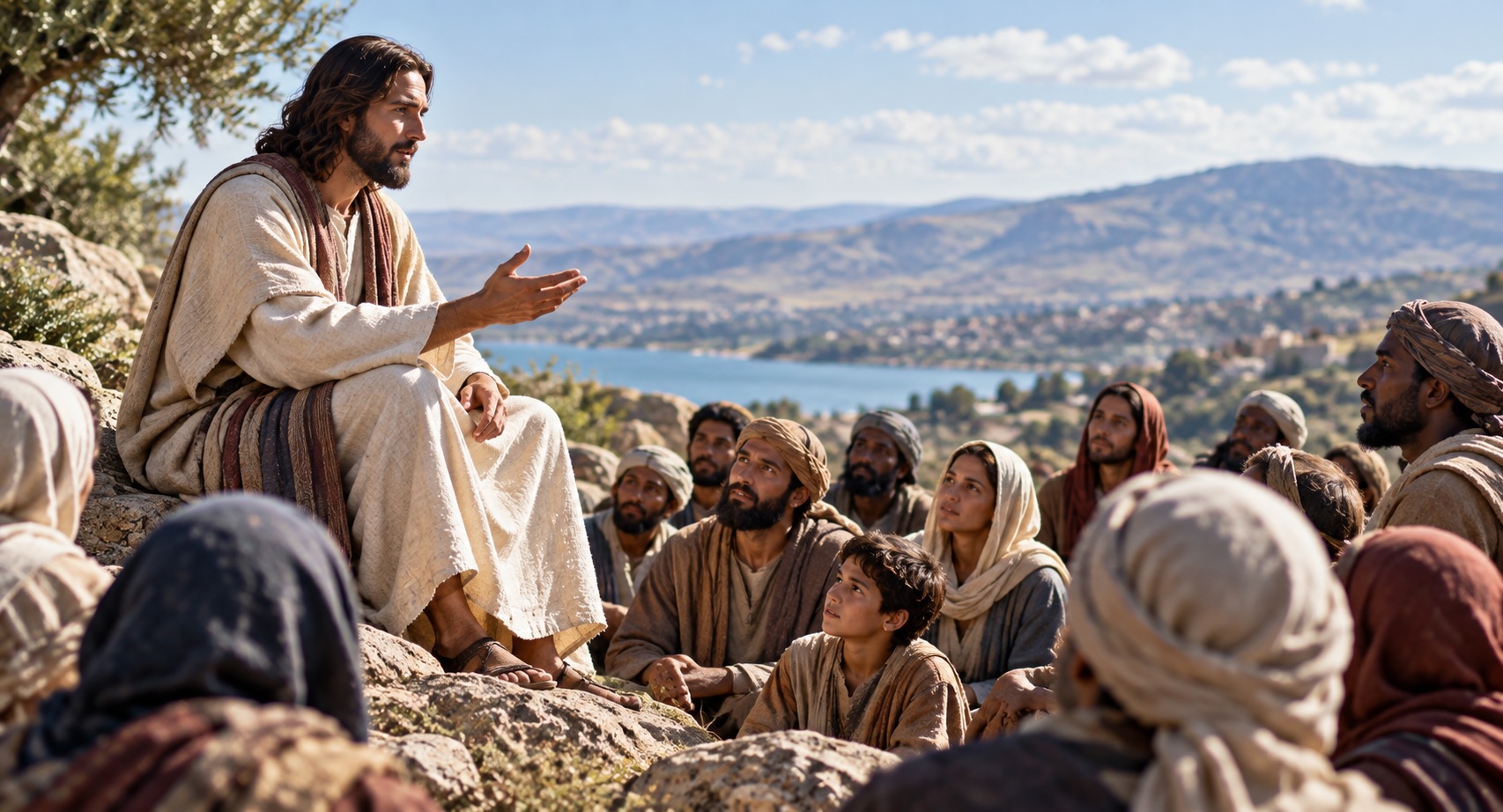
Blessed Are the Poor in Spirit
Being poor in spirit doesn’t mean having low self-esteem or believing that you have no value. It means recognizing our spiritual need for God. We cannot save ourselves. We cannot make ourselves righteous before God through accomplishments, possessions, intelligence or good works.
A person who is poor in spirit understands:
I need God.
That humility is where our relationship with Him begins. Pride tells us, “I can do this myself.” Humility says, “God, I need You.”
Jesus promises that the Kingdom of Heaven belongs to those who recognize their need for Him.
For Theirs Is The Kingdom Of Heaven.
What does this look like today?
- Being poor in spirit means coming before God honestly.
- It means admitting our sin.
- It means asking for forgiveness.
- It means recognizing that our salvation depends upon Jesus rather than ourselves.
Blessed Are Those Who Mourn
Life can hurt. We lose people we love. Relationships break. Dreams disappear. Families struggle. People become sick. We experience disappointment, loneliness and grief.
Jesus never promised that following Him would make us immune to sorrow. Instead, He promised comfort.
For They Will Be Comforted.
God sees our grief. Jesus understood sorrow Himself. He wept at the death of Lazarus. He experienced rejection, betrayal, pain and loss.
But mourning can also include something else: grieving over sin and the brokenness we see in ourselves and the world around us. When we recognize how far humanity has wandered from God, that realization should affect us.
The promise is not that God’s people will never cry. The promise is that our sorrow is not the end of the story.
God offers comfort, hope and ultimately restoration.
Blessed Are the Meek
Our culture often associates strength with power, influence, dominance or getting the last word. Jesus praised something very different: meekness.
Meekness does not mean weakness. A meek person may have strength, authority and ability but chooses humility and self-control rather than arrogance or aggression.
Jesus Himself described His heart as gentle and humble.
- Being meek means we do not have to prove ourselves to everyone.
- We do not have to win every argument.
- We do not have to retaliate every time someone hurts us.
We can trust God with our reputation, our future and the outcome.
That requires more strength than anger often does. Jesus promises:
For They Will Inherit The Earth.
Blessed Are Those Who Hunger and Thirst for Righteousness
Think about what happens when you’re truly hungry or thirsty. You want food. You search for water. Nothing else completely satisfies that need.
Jesus said followers of God should desire righteousness with that same intensity.
Righteousness means wanting what is right in God’s eyes. It means wanting our lives to reflect His truth. It means wanting justice, goodness and obedience to God—not only when it is convenient, but because we genuinely desire Him.
Ask yourself:
What am I hungry for?
- Approval?
- Money?
- Success?
- Attention?
- Comfort?
Or do I hunger to know God and live the way He wants me to live?
Jesus promises that those who truly hunger and thirst for righteousness will be filled.
For They Will Be Filled.
Blessed Are the Merciful
Mercy can be difficult. It is easy to want mercy when we are the one who has made the mistake. It can be much harder to give mercy when someone has hurt us.
But followers of Jesus are called to remember the mercy God has shown us. We have sinned. We have made mistakes. We have failed.
Yet through Jesus Christ, God offers forgiveness.
For They Will Be Shown Mercy.
When we understand how much mercy we have received, it should change the way we treat other people.
Being merciful doesn’t mean pretending wrongdoing never happened. It doesn’t mean remaining in an abusive or dangerous situation, and it doesn’t mean eliminating wise boundaries.
- Mercy means refusing to let hatred control our hearts.
- Mercy means showing compassion.
- Mercy means being willing to forgive.
- Mercy means treating others with the grace we ourselves desperately need.
Blessed Are the Pure in Heart
God is concerned with more than appearances. People see what we do. God sees why we do it. A person can appear religious on the outside while having very different motives inside.
Jesus repeatedly challenged that kind of hypocrisy. Being pure in heart means sincerely desiring God rather than merely trying to appear righteous in front of others.
Our motives matter. Our thoughts matter. What we do when nobody else sees us matters.
The goal is not simply:
“How can I look like a Christian?”
The better question is:
“Does my heart truly belong to God?”
Jesus promises something extraordinary to the pure in heart:
For They Will See God.
Blessed Are the Peacemakers
Notice Jesus didn’t simply say blessed are the people who like peace. He said blessed are the peacemakers.
Peacemakers take action:
- They don’t constantly stir up arguments, gossip or division.
- They try to bring people together.
- They listen.
- They forgive.
- They speak truth without unnecessarily trying to hurt people.
- They are willing to apologize when they are wrong.
- They look for reconciliation when reconciliation is possible.
This doesn’t mean ignoring truth just to avoid conflict. Jesus never avoided truth.
Biblical peace is not pretending problems don’t exist. A peacemaker confronts problems in a way that seeks healing rather than destruction.
Jesus says peacemakers will be called children of God:
For They Will Be Called Children Of God
Blessed Are Those Who Are Persecuted Because of Righteousness
Following Jesus will not always make us popular. Jesus warned His followers that there would be times when people insulted them, lied about them or persecuted them because they belonged to Him.
Christian faith should never be used as an excuse for treating others badly and then calling their reaction “persecution.” But there are times when faithfully following Christ can cost us something:
- It may cost friendships.
- Popularity.
- Opportunities.
- Acceptance.
In some parts of the world, Christians face much more serious consequences because of their faith.
Jesus tells His followers not to measure their standing with God by how popular they are with the world. Our ultimate reward is not found in people’s approval.
It is found with God.
For Theirs Is The Kingdom Of Heaven.
Blessed are you when people insult you, persecute you and falsely say all kinds of evil against you because of me. Rejoice and be glad, because great is your reward in heaven, for in the same way they persecuted the prophets who were before you.
The Beatitudes in Luke
The Gospel of Luke also records Jesus teaching blessings in Luke 6:20-23, followed by a series of warnings or “woes” in verses 24-26.
Luke records Jesus speaking about those who are poor, hungry, grieving and rejected because of the Son of Man. He then contrasts them with people who find their security only in present wealth, comfort, satisfaction and human approval.
Matthew and Luke together remind us of an important truth:
This world is not all there is.
Our present circumstances do not determine our eternal standing with God. And having everything we want right now does not necessarily mean that our relationship with God is right.
Are the Beatitudes Commandments?
The Beatitudes are different from commands such as “Do not murder” or “Do not steal.”
Jesus is describing the character of people whose lives are being transformed by God.
The Beatitudes show us what discipleship looks like from the inside out. A follower of Jesus increasingly becomes:
- humble before God
- sensitive to sin and suffering
- gentle rather than arrogant
- hungry for righteousness
- merciful toward others
- pure in heart
- willing to make peace
- faithful even when following Christ becomes difficult
These qualities do not earn salvation. They are characteristics we should increasingly see as we follow Christ.
The Beatitudes Turn the World’s Values Upside Down
- The world often tells us: Be powerful. Jesus teaches meekness.
- The world says: Put yourself first. Jesus teaches mercy.
- The world says: Do whatever makes you happy. Jesus teaches us to hunger for righteousness.
- The world says: Get even when someone hurts you. Jesus teaches mercy and peacemaking.
- The world says: Your reputation is everything. Jesus says we may sometimes be rejected because we follow Him.
The world focuses heavily on outward success. Jesus focuses on the heart. That is one reason the teachings of Jesus remain so challenging.
He doesn’t simply tell us to behave differently. He calls us to become different.

How Can I Live the Beatitudes Today?
The Beatitudes aren’t meant only to be read. They are meant to change us.
- Start with humility. Tell God honestly where you need Him.
- When you are hurting, bring your grief to Him instead of assuming He doesn’t care.
- When you’re angry, ask whether meekness and self-control would honor God more than retaliation.
- Examine what you truly hunger for.
- Practice mercy when someone disappoints you.
- Ask God to reveal impure motives in your heart.
- Look for opportunities to bring peace instead of division.
And when following Jesus becomes difficult, remember that your faithfulness is seen by God even when it isn’t appreciated by others.
None of us will live these teachings perfectly. That’s another reason we need Jesus.
The Beatitudes Point Us Back to Jesus
When we read the Beatitudes carefully, we see many of these qualities perfectly demonstrated in Jesus Himself.
- Jesus was humble.
- Jesus had compassion for people who were hurting.
- Jesus was gentle, yet never weak.
- Jesus perfectly desired righteousness.
- Jesus showed extraordinary mercy.
- Jesus was pure in heart.
- Jesus came to make peace between sinful humanity and God.
- And Jesus was persecuted despite being completely righteous.
The Beatitudes aren’t simply good advice about becoming a nicer person. They point us toward the life Christ calls us to live. And we cannot truly understand that life without first understanding who Jesus is.
What Do the Beatitudes Mean for You?
Jesus’ words challenge each of us to look deeper than outward appearances.
Ask yourself:
- Do I recognize how much I need God?
- Where do I need His comfort?
- Am I becoming more humble or more prideful?
- Do I truly desire righteousness?
- Do I show mercy?
- Are my motives pure?
- Do I create peace or conflict?
- Would I continue following Jesus even if other people rejected me for it?
The Beatitudes remind us that God’s priorities are often very different from ours.
True blessing isn’t simply getting everything we want. True blessing is knowing God, belonging to His Kingdom and becoming the person He created us to be.
And it all begins with Jesus.
Want to Know More About Jesus?
If you’re reading the Beatitudes and wondering who Jesus really is, start with Who Is Jesus? Learn about His life, His claims, the witnesses to His resurrection and why Christians believe He is the Son of God.
If you already believe in Jesus but aren’t sure what it means to be saved, read What Is Salvation?
And if you’re ready to turn to God and don’t know what to say, visit the Simple Salvation Prayer.
Frequently Asked Questions About the Beatitudes
The Beatitudes are teachings Jesus gave at the beginning of the Sermon on the Mount in Matthew 5:3-12. They describe the character and attitudes of people who belong to God’s Kingdom, including humility, mercy, purity of heart, righteousness, peacemaking and faithfulness.
The Greek word translated “blessed” is makarios (μακάριος). It carries a richer meaning than the English word happy alone and can express the idea of being blessed, fortunate or in a deeply favorable position.
In the Beatitudes, Jesus isn’t promising that His followers will always feel happy or have easy lives. He is describing people who are truly blessed because of their relationship with God and the promises of His Kingdom.
The Greek word makarios corresponds closely to the Hebrew biblical expression ashrei, often translated “blessed” or “happy.” We see ashrei used in passages such as Psalm 1:1, traditionally translated, “Blessed is the one…”
Both expressions communicate something deeper than temporary happiness. They describe the fortunate or blessed condition of a person whose life is rightly connected to God.
The best-known Beatitudes are found in Matthew 5:3-12, at the beginning of Jesus’ Sermon on the Mount. Related blessings and warnings are also recorded in Luke 6:20-26.
The Beatitudes are commonly counted as eight, based on Matthew 5:3-10. Matthew 5:11-12 continues and expands Jesus’ teaching about being persecuted because of Him, so some traditions count this final statement separately.
To be poor in spirit means recognizing our spiritual need for God. It is an attitude of humility that acknowledges we cannot save ourselves or make ourselves righteous before God through our own efforts.
It is essentially admitting:
“God, I need You.”
Jesus was not saying that sadness itself is something we should seek. He was promising God’s comfort to those who mourn.
This can include grief over loss and suffering as well as sorrow over sin and the brokenness of our world. The promise reminds us that grief is not the end of the story for those who belong to God.
Biblical meekness does not mean weakness.
Meekness involves humility, gentleness and strength under control. A meek person doesn’t need to dominate others, retaliate for every offense or constantly prove themselves.
Jesus Himself demonstrated this kind of strength.
To hunger and thirst for righteousness means deeply desiring what is right according to God.
Just as physical hunger makes us seek food and thirst makes us seek water, Jesus teaches that His followers should genuinely desire God’s truth, goodness and righteousness.
Being pure in heart means sincerely seeking God rather than merely appearing religious to other people.
Jesus repeatedly taught that God is concerned not only with our outward behavior but also with our thoughts, motives and intentions.
A peacemaker is someone who actively seeks peace, healing and reconciliation rather than unnecessarily creating conflict and division.
Being a peacemaker does not mean ignoring wrongdoing or compromising truth. Biblical peacemaking seeks to address problems in ways that lead toward restoration rather than destruction.
Jesus taught that people who remain faithful to God despite persecution should not measure their relationship with God by the world’s approval.
Someone may be rejected by people and still be blessed by God.
Jesus reminds His followers that earthly rejection is temporary, while God’s promises are eternal.
The Beatitudes are not commandments in the same form as “Do not murder” or “Do not steal.”
Instead, they describe the heart and character of a person whose life is being transformed by God.
The Beatitudes show us qualities that should increasingly characterize followers of Jesus: humility, mercy, righteousness, purity, peacemaking and faithfulness.
The Beatitudes are not a checklist for earning salvation.
The Bible teaches that salvation comes through Jesus Christ, not by successfully completing a list of good works. The Beatitudes instead show us the kind of character and spiritual transformation that should develop as we follow Christ.
Absolutely.
Pride, grief, anger, injustice, unforgiveness, impure motives, conflict and pressure to compromise our beliefs are still part of human life.
Jesus’ teachings about humility, mercy, righteousness, purity, peacemaking and faithfulness are just as relevant today as when He first spoke them.
The Beatitudes teach us that God’s definition of a blessed life is very different from the world’s definition of success.
The world often measures blessing by money, comfort, popularity, power and accomplishments.
Jesus points us toward something deeper.
True blessing is found in knowing God, belonging to His Kingdom and allowing Him to transform who we are from the inside out.