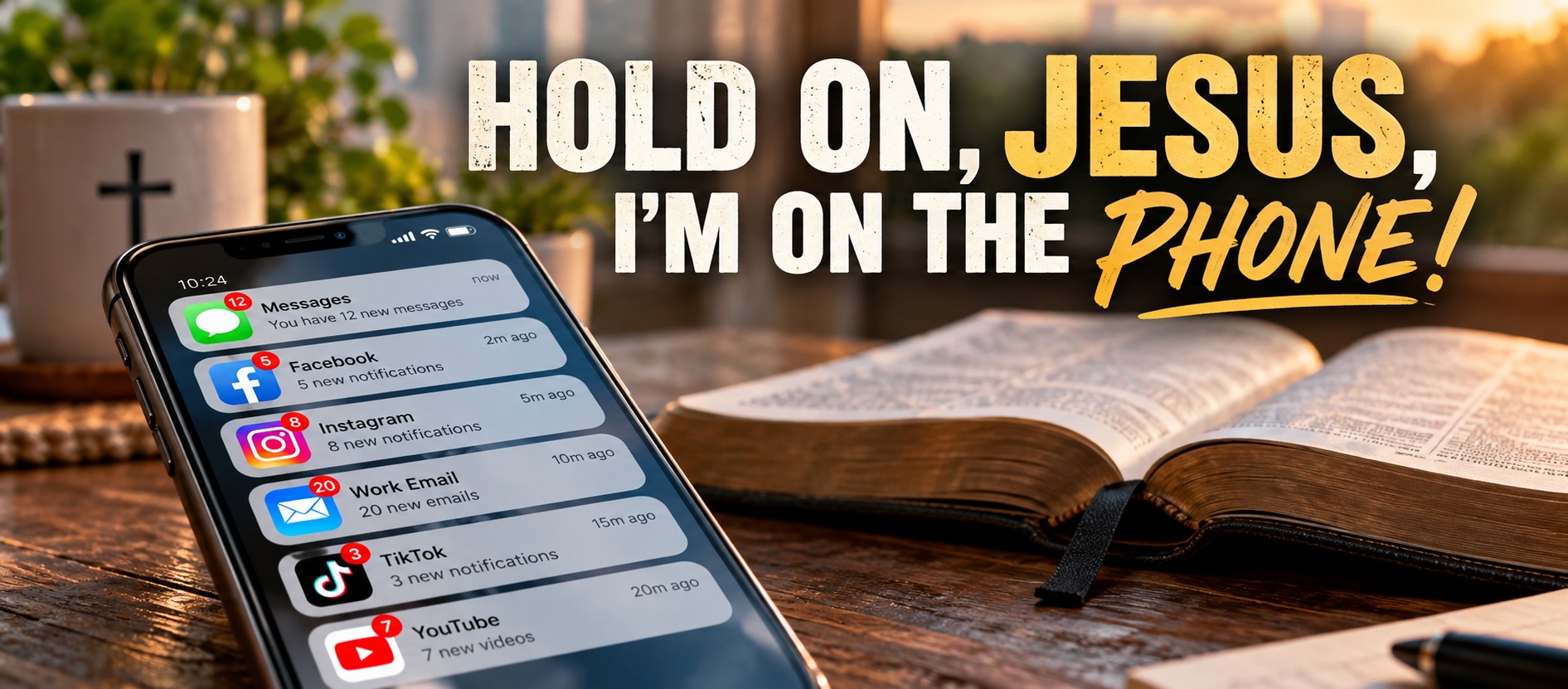
Are We Giving Jesus What’s Left of Our Time?
Imagine Jesus sitting beside you, wanting to spend time with you. But your phone buzzes, and you reach for it.
“Hold on, Jesus. I need to answer this.”
Then another notification arrives. Someone commented on your Facebook post. There’s a video you want to watch, finish up a game, a message you need to answer, and an argument in the comments that you just can’t let go.
Before you know it, an hour has passed. You finally put down your phone, but now there’s work to finish, dinner to prepare, laundry to fold, and a television show you don’t want to miss.
Maybe tomorrow, Jesus.
Does that sound familiar? We live in a world where nearly everything competes for our attention. Our phones, careers, social media, entertainment, money, and even our personal ambitions can slowly take priority over our relationship with God.
The problem isn’t necessarily that we’re doing bad things. Sometimes we’re so busy doing ordinary things that we forget the One who gave us life in the first place. Jesus doesn’t want to be another appointment on our calendar. He wants to be the center of our lives.
“But seek first his kingdom and his righteousness, and all these things will be given to you as well.” – Matthew 6:33
This isn’t a suggestion to fit God into our lives when it’s convenient. Jesus tells us where our priorities should begin.
What Does Putting God First Have to Do With Jesus?
When we talk about putting God first, we’re also talking about putting Jesus first. Christians believe in one God who exists eternally as Father, Son, and Holy Spirit. Jesus is God the Son, who came into the world to save us and reconcile us to the Father. Jesus said in John 14:6 that no one comes to the Father except through Him. Putting God first means following Jesus, trusting His Word, and allowing Him to guide every part of our lives.
“I am the way and the truth and the life. No one comes to the Father except through me.” – John 14:6
Jesus is God the Son, who came into the world to save us and reconcile us to the Father. If you’re still wondering Who Is Jesus?, discover what the Bible tells us about His identity, His life, and His resurrection.”
When Did Our Phones Become More Important Than Jesus?
Think about the first thing you do when you wake up. Do you reach for your phone before you even get out of bed? Check your messages, read the latest headlines, scroll through Facebook, or see how many people liked your latest post?
How often do we spend 30 minutes scrolling through social media but struggle to find five minutes to pray?
Our phones have become our alarm clocks, calendars, cameras, entertainment centers, shopping malls, and connection to the outside world. They are useful tools, but they can also become some of the biggest distractions in our spiritual lives.
We can be connected to hundreds of people and still neglect our relationship with Jesus.
Consider how different our mornings might look if we spoke to Jesus before checking our notifications, read Scripture before reading social media, and thanked God for another day before worrying about everything we need to accomplish.
What gets our first attention often reveals what has our greatest influence.
Social Media: Are We Living in Reality or Someone Else’s Perception?
Social media gives us an opportunity to communicate, encourage others, share our faith, and stay connected with people we love. But it also creates a world where appearances can become more important than reality. We see perfectly decorated homes, happy marriages, expensive vacations, beautiful families, successful businesses, and people who seem to have everything figured out.
What we don’t always see are their struggles, financial problems, arguments, loneliness, insecurities, and disappointments.
We compare our ordinary lives to someone else’s carefully selected highlights. And sometimes, without even realizing it, we begin measuring our own happiness, success, and worth by what other people post.
But God doesn’t measure us by our followers, possessions, appearance, or popularity. He looks at our hearts.
What is social media really doing to us?
Comparison and jealousy
We compare our marriages, children, homes, bodies, and accomplishments with people whose real circumstances we may know very little about.
False information and gossip
We share sensational headlines, unverified stories, rumors, and accusations without stopping to determine whether they’re true. Sometimes we participate in damaging someone’s reputation without knowing the facts.
Arguments with complete strangers
We spend hours arguing with people we’ve never met over politics, religion, parenting, and other disagreements. We become angry, defensive, and sometimes cruel toward people Jesus commands us to love.
Seeking approval and attention
Our mood begins depending on likes, shares, compliments, and comments. We may become more concerned with how strangers see us than how we are living before God.
Losing hours of our lives
A few minutes of scrolling turns into an hour. We stay up late watching videos, playing games, neglect our sleep, procrastinate, and put off things that genuinely need our attention.
Cyberbullying and dangerous relationships
People hide behind screens to insult, threaten, or humiliate others. Children and adults can also be manipulated by strangers who misrepresent who they are.
Temptation and inappropriate content
Endless access to pornography, provocative images, gambling, materialism, and other temptations can gradually influence our desires and behavior.
Living for content instead of living our lives
Instead of enjoying a meaningful moment, we become preoccupied with recording it, editing it, posting it, and watching other people’s reactions.
Romans 12:2 reminds believers not to conform to the pattern of this world but to be transformed by the renewing of their minds.
“Do not conform to the pattern of this world, but be transformed by the renewing of your mind. Then you will be able to test and approve what God’s will is—his good, pleasing and perfect will.” – Romans 12:2
That includes being intentional about what we allow into our minds every day. Jesus should influence how we use social media, not the other way around.
Social media, money, success, and even our phones can become modern-day idols when we allow them to take God’s place. Learn more about how the Ten Commandments apply to our everyday lives .
We’re So Busy Recording Life That We Forget to Help Others
Imagine witnessing a car accident, someone being bullied, an elderly person falling, or a parent desperately searching for a missing child. What’s our first instinct? Do we step forward and help, or do we pull out our phones to record what’s happening?
Of course, recording certain situations can provide important evidence or help keep people accountable. But when someone genuinely needs assistance, our desire to capture a video should never become more important than their safety or well-being.
We see videos of people being humiliated, fighting, crying, and experiencing some of the worst moments of their lives. Thousands of strangers watch, comment, laugh, and share. Some people are so concerned with getting views that they forget there’s a real human being on the other side of the camera.
What would Jesus have us do?
In Luke 10:25–37, Jesus tells the parable of the Good Samaritan. A man had been beaten, robbed, and left on the road. Two religious men saw him and passed by, but a Samaritan stopped to help.
He didn’t ignore the injured man because he was too busy. He showed compassion, cared for his wounds, took him somewhere safe, and paid for his continued care.
Jesus ends the parable by telling us to go and do likewise.
Our responsibility as Christians isn’t simply to observe suffering. It’s to show compassion and respond when we can.
Sometimes that means putting down our phones, calling emergency services, helping someone who has fallen, standing up for someone being mistreated, or comforting someone who is hurting.
We don’t have to put ourselves in danger to demonstrate Christ’s love. But we should never become so consumed with creating content that we lose our compassion for other people.
Before you reach for your camera, ask yourself: Is there something Jesus would rather have me do right now?
We don’t have to do something extraordinary to make a difference. Sometimes the smallest acts of kindness can have the greatest impact. Discover more simple ways to serve God by serving others .
Is Your Phone Stealing Time From the People God Gave You?

Sometimes the people who receive the least attention from us are the very people sitting beside us.
We spend our days answering emails, returning calls, responding to messages, and interacting with strangers online. Then we come home, sit on the couch, and continue staring at our phones.
Our spouses want to talk, but we’re distracted. Our children want to show us something, but we’re busy. Our parents call, but we send them to voicemail because we’re watching a video. We’re physically present but emotionally unavailable.
Our spouses deserve more than our leftover attention
Marriage requires communication, companionship, patience, forgiveness, and intentional love.
- How can we build a strong marriage when we spend our evenings scrolling through our phones instead of talking to each other?
- How many conversations have ended with “Are you even listening to me?”
- How many couples go out to dinner only to spend most of the meal looking at separate screens?
- And how many relationships are being damaged by inappropriate online conversations, secret messages, comparisons with other people’s marriages, or emotional attachments formed through social media?
Ephesians 5:25 calls husbands to love their wives as Christ loved the church. Scripture also teaches mutual consideration, respect, and love within marriage.
“Husbands, love your wives, just as Christ loved the church and gave himself up for her.” – Ephesians 5:25
Putting Jesus first should change how we treat our spouses. It should make us more attentive, faithful, patient, and willing to put someone else’s needs ahead of our own. The Apostle Paul reminds us that genuine love is patient, kind, and not self-seeking. Read more about what the Bible teaches us about real love and how it should influence our relationships.
Our children need our presence, not just our pictures
Children grow up quickly. There will come a day when they stop asking us to play, stop running to show us their drawings, and stop wanting us to sit beside them. How many of those moments are we missing because we’re distracted by our phones?
It’s wonderful to take pictures of our children and preserve memories. But they also need us to participate in those memories. They need us to listen to their stories, answer their questions, attend their activities, teach them right from wrong, and help them develop their own relationship with Jesus.
Deuteronomy 6:6–7 instructs God’s people to impress His commandments upon their children and talk about them throughout their everyday lives
“These commandments that I give you today are to be on your hearts. 7 Impress them on your children. Talk about them when you sit at home and when you walk along the road, when you lie down and when you get up.” – Deuteronomy 6:6-7
That kind of teaching requires time, attention, and a living example. Our children learn what matters by watching what matters to us. If they constantly see us putting our phones before our families, how can we expect them to develop different priorities?
Our Parents Need Our Attention, Too!
We often talk about parents spending too much time on their phones and neglecting their children. But what about children who are so consumed with their phones, social media, friends, and busy schedules that they forget about their parents?
And this doesn’t apply only to teenagers. As adults, we can become so caught up in our careers, families, and everyday responsibilities that we forget our aging parents need us, too.
For teenagers: Your parents need more than one-word answers.
How many times have your mom or dad tried to have a conversation with you while you continued scrolling through your phone? Do you get irritated when they interrupt your game, ask you to put your phone away at dinner, or want to know how your day went?
Your parents aren’t going to be around forever. Those conversations you find annoying today may be the very ones you wish you could have again someday.
Put down your phone. Talk to your parents. Help with chores without having to be asked repeatedly. Spend time together, listen to their advice, and show them the same patience you want them to show you. Honoring your parents isn’t just about obeying rules. It’s about showing love, gratitude, and respect.
For adult children: Your aging parents still need you.
As our parents get older, their needs change. The people who once cared for us, drove us to school, helped us through difficult times, and made sacrifices for our futures may eventually need us to do some of those same things for them.
Maybe your mom lives alone and looks forward to your phone calls. Perhaps your dad needs help with household repairs, grocery shopping, medical appointments, or simply figuring out how to use his phone.
Sometimes they don’t need anything other than someone to sit with them, listen to their stories, or take them out to lunch. Yet we tell ourselves we’ll call tomorrow, visit next weekend, or stop by when things slow down. Meanwhile, we somehow find time to scroll through Facebook, watch endless videos, and read about the lives of people we barely know.
Our parents won’t always be here. Don’t wait until they’re gone to wish you had spent more time with them.
And if you’re caring for an elderly parent, remember that showing love doesn’t mean you have to do everything yourself. Sharing responsibilities with family members and seeking additional help when necessary are also ways to ensure your parents receive the care they need.
“But if a widow has children or grandchildren, these should learn first of all to put their religion into practice by caring for their own family and so repaying their parents and grandparents, for this is pleasing to God.” – 1 Timothy 5:4
Of course, not everyone has a healthy relationship with their parents. Honoring them doesn’t mean accepting abuse, ignoring necessary boundaries, or placing yourself in danger. But where healthy relationships are possible, we should make an effort to nurture them.
Putting Jesus first should make us more loving and attentive toward our parents, not less. Sometimes serving God is as simple as putting down our phones, calling Mom or Dad, and reminding them that they haven’t been forgotten.
Caring for our parents is one of the many ways we can demonstrate God’s love. Explore other simple ways to serve God through everyday acts of kindness and compassion.
What About Our Responsibilities at Home?
It’s easy to lose track of time when we’re watching videos, playing games, or scrolling through social media.
Meanwhile, the dishes are piling up, laundry needs washing, bills need paying, dinner hasn’t been prepared, and someone else is carrying the responsibilities we’ve been avoiding. Perhaps our spouse is handling everything while we sit on the couch. Or we’re telling our children to get off their devices while we’re constantly looking at our own.
Putting Jesus first doesn’t mean neglecting our everyday responsibilities to spend every waking moment reading the Bible. It means honoring Him through the way we live, including the ordinary work that keeps our families and households functioning.
Colossians 3:23 teaches us to work wholeheartedly, as though working for the Lord.
“Whatever you do, work at it with all your heart, as working for the Lord, not for men…: – Colossians 3:23
That applies to more than our careers. It can influence how we care for our homes, keep our commitments, manage our finances, raise our children, and share responsibilities with our spouses.
A clean house isn’t a measure of someone’s faith, and there are seasons when simply getting through the day is an accomplishment. But habitually neglecting people and responsibilities because we’d rather be on our phones is worth examining.
Serving Jesus begins with how we live when nobody is watching.
When Work, Money, and Success Come Before Jesus
Our phones aren’t the only things competing for first place in our lives. Sometimes it’s our careers. We convince ourselves that we have to work longer hours, earn more money, answer every email immediately, and continually pursue the next opportunity.
There’s nothing wrong with working hard, providing for our families, or wanting to succeed. Scripture encourages diligence and responsible stewardship.
But what happens when our work consumes us? We stop attending church because we’re too busy. We postpone prayer because we have another deadline. We miss family gatherings because we can’t stop working. We become so focused on earning a living that we forget why we’re living.
Jesus asks a powerful question in Mark 8:36:
“What good is it to gain the whole world but forfeit your soul?” – Mark 8:36
Money can buy a beautiful house, but it cannot buy salvation. A successful career may bring recognition, but it cannot replace our relationship with God.
We can pursue our careers while keeping Jesus first. We do that by conducting business honestly, treating people fairly, making time for worship, honoring our family commitments, and refusing to sacrifice our integrity for financial gain.
Our work should be an opportunity to honor Jesus, not a replacement for Him.
Anything We Put Above God Can Become an Idol
When we hear the word idol, we might picture a golden statue or an ancient pagan temple. But idols aren’t always objects we physically bow down to. Anything that captures our ultimate devotion, becomes the source of our identity, or takes the place that belongs to God can become an idol in our lives. God’s command to have no other gods before Him is just as relevant today as it was when He gave Moses the Ten Commandments .
Martha Was Busy, but Mary Chose Jesus
One of the clearest biblical examples of misplaced priorities comes from the story of Mary and Martha in Luke 10:38-42. When Jesus visited their home, Martha became busy preparing and serving while Mary sat at Jesus’ feet, listening to His teaching.
Martha was frustrated because Mary wasn’t helping her. She asked Jesus to tell Mary to get up and assist. But Jesus gently corrected Martha. He explained that she was worried and distracted by many things, while Mary had chosen what was better.
Martha wasn’t doing something sinful by preparing food and showing hospitality. Her problem was allowing those responsibilities to distract her from the importance of being with Jesus.
Doesn’t that sound like us sometimes? We have errands to run, deadlines to meet, houses to clean, messages to answer, and endless things demanding our attention. But Jesus is inviting us to spend time with Him.
We can become so busy serving, working, and managing our lives that we forget to sit at His feet. Don’t become so busy doing things that you forget the One you’re supposed to be living for.
Putting Jesus First Means More Than Putting Down Your Phone
It’s possible to put our phones away, delete our social media accounts, and still fail to put Jesus first. Why? Because the real issue is our hearts.
- Putting Jesus first means trusting Him, obeying His Word, seeking His guidance, and allowing His teachings to influence our everyday decisions.
- It means choosing honesty when lying would be easier, forgiveness when we’re angry, generosity when someone needs help, and compassion when we encounter people who are struggling.
- It means caring more about God’s approval than the approval of strangers.
- And it means recognizing that we need Jesus every day, not just on Sundays or when something goes wrong.
In John 15, Jesus describes Himself as the vine and His followers as the branches. Our spiritual lives depend on remaining connected to Him. Without that relationship, our religious activities can become empty routines.
Our goal isn’t simply to spend less time looking at a screen. It’s to make more room in our hearts and lives for Jesus.
Practical Ways to Put Jesus First Every Day
A simple starting point for Christians who want to build healthier habits and grow closer to God:
- Talk to Jesus before checking your phone in the morning.
- Read a passage of Scripture before opening social media.
- Put your phone away during meals and conversations with your family.
- Set aside uninterrupted time for prayer and Bible study.
- Stop participating in online arguments that produce anger instead of understanding.
- Verify information before sharing it, and refuse to spread gossip.
- Turn off unnecessary notifications and establish reasonable screen-time limits.
- Be fully present when your spouse, children, parents, or friends need your attention.
- Use your phone to encourage others, share Scripture, and offer genuine help.
- End each day by thanking God and reflecting on how you spent your time.
These changes don’t require us to abandon technology or withdraw from the world. They simply help us become more intentional about what receives our time and attention. We can also ask Jesus to show us the distractions we haven’t recognized yet.
Perhaps it’s not social media at all. Maybe it’s an obsession with our careers, our children’s achievements, our appearance, our possessions, or our desire to be right about everything. Whatever it is, we can bring it before Him.

Jesus Shouldn’t Have to Compete for Our Attention
One day, our phones will be replaced, our social media posts will be forgotten, our careers will end, and many of the things we spent our lives chasing will no longer matter. But our relationship with Jesus has eternal significance.
When Jesus returns, will we have spent our lives pursuing Him, loving others, and doing what He called us to do? Or will we have spent so much time distracted by this world that we neglected what mattered most? Our phones, social media, work, and everyday responsibilities can easily become distractions from God when we allow them to take priority over spending time with Jesus and living according to His Word.
We don’t know the day or hour of His return. But we do know what He has called us to do while we wait. Love God. Love others. Share the Gospel. Serve those in need. Be faithful with what He has entrusted to us. While we wait for Jesus’ return, we have a purpose here on earth. Discover what believers should be doing while awaiting the coming of the Lord.
We cannot recover yesterday’s wasted hours, but we can make different choices today. Jesus isn’t asking us to have a perfectly organized schedule, an immaculate home, or a life without distractions. He calls us to follow Him, even when that requires changing our habits and priorities.
The Next Time Your Phone Rings…
Before you automatically reach for it, consider whether something—or someone—more important needs your attention.
Maybe your child wants to talk. Maybe your spouse needs your help. Maybe someone nearby needs a little compassion. Or maybe it’s simply time to put everything aside and spend a few quiet moments with Jesus.
Don’t spend your whole life telling Jesus to hold on.
A Prayer for Putting Jesus First
Heavenly Father,
Forgive me for the times I’ve allowed my phone, social media, work, and worldly distractions to become more important than my relationship with You.
Help me recognize when I’m wasting time, neglecting my family, comparing myself to others, or becoming involved in things that don’t honor You.
Teach me to be present with the people You’ve placed in my life. Give me wisdom to use technology responsibly, discernment to recognize what is true, and compassion to help others instead of simply watching from the sidelines.
Most importantly, Jesus, help me put You first. Not just when I have extra time, but in everything I do.
Change my priorities, guide my decisions, and help me live each day with an eternal perspective.
In Jesus’ name, Amen.
Frequently Asked Questions
Using a phone isn’t inherently sinful. However, when phone use leads us to neglect God, mistreat others, ignore responsibilities, or repeatedly give in to temptation, we need to examine our priorities. First Corinthians 6:12 reminds us not to allow ourselves to be mastered by anything.
“Everything is permissible for me” – but not everything is beneficial. “Everything is permissible for me” – but I will not be mastered by anything.” – 1 Corinthians 6:12
Jesus teaches in Matthew 6:33 that we should seek God’s kingdom and righteousness first. Matthew 22:37–38 also identifies loving God with all our heart, soul, and mind as the greatest commandment. Putting Jesus first means allowing our relationship with Him to guide our decisions, relationships, and daily activities.
The Bible doesn’t address modern social media directly. Christians can use these platforms to share their faith, encourage others, and maintain relationships. However, we should be mindful of dishonesty, gossip, arguments, comparison, inappropriate content, and excessive screen time.
Start with prayer, spend time reading Scripture, and look for opportunities to honor Jesus throughout your day. Caring for your family, doing your work honestly, helping others, and making thoughtful decisions can all reflect your commitment to Him. Putting Jesus first is about the direction of your life, not simply the number of minutes you spend reading the Bible.
Yes. Social media can become an idol when it receives the devotion, attention, or importance that belongs to God. If our identity, happiness, and sense of worth depend on online attention rather than our relationship with Him, it’s worth reconsidering our priorities.
James 1:19–20 teaches us to be quick to listen, slow to speak, and slow to become angry. Before responding to a disagreement, consider whether your words are truthful, necessary, respectful, and likely to accomplish anything constructive. Sometimes the wisest response is to stop participating.
“My dear brothers, take note of this: Everyone should be quick to listen, slow to speak and slow to become angry, for man’s anger does not bring about the righteous life that God desires.” – James 1:19-20