
Is Jesus Real? Eyewitness Testimony and Evidence for Jesus Christ
Was Jesus a real person? And if He was, how can we know that what the Bible says about Him is true?
These are fair questions.
You do not have to be afraid to ask questions about Jesus. Christianity does not begin with a command to ignore the evidence. The New Testament repeatedly points us toward witnesses—people who said they saw Jesus, heard Him, followed Him, watched what happened to Him, and later testified about what they had witnessed.
John’s eyewitness testimony puts it very simply:
“I have seen and I testify that this is the Son of God.” – John 1:34
And near the end of the Gospel of John, we are told:
“This is the disciple who testifies to these things and who wrote them down. We know that his testimony is true.” — John 21:24 NIV
Those two statements give us an important reason to take a closer look.
The message about Jesus was presented as testimony. So rather than repeating the story of Jesus’ birth, genealogy, or everything He taught, let’s look at a different question:
Who witnessed Jesus?
If you’re wondering not only whether Jesus existed but who Jesus really is, take a closer look at what the Bible says about His identity, His humanity, His claims, and why Christians believe He is the Son of God.

Christianity Is Built Around Testimony
When we hear the word testimony, we often think about a courtroom. A witness tells what he or she saw, heard, or experienced.
Interestingly, the Gospel of John repeatedly uses this same idea when presenting Jesus. John does not simply tell his readers, “Believe this because I said so.” He presents eyewitnesses of Jesus:
- John the Baptist testified.
- The disciples testified.
- Jesus’ works testified.
- The Scriptures testified.
- God the Father testified.
- And those who saw Jesus after His resurrection testified.
John wanted his readers to understand that the claims about Jesus were not being presented as a secret spiritual philosophy. They were claims about events that happened in the real world.
A Quick Note: There Are Two Different Johns
It’s easy to get confused when reading the New Testament because John the Baptist and John the Apostle are two different people. John the Baptist was the messenger who prepared the way for Jesus and publicly testified about who He was. John the Apostle was one of Jesus’ twelve disciples, followed Him during His ministry, and is traditionally associated with the Gospel of John. So when we read John the Baptist’s testimony in John 1:34 and then the testimony connected with the disciple in John 21:24, we are reading about two different Johns pointing us toward the same Jesus.
John the Baptist Said, “I Have Seen”
John the Baptist was one of the earliest people to publicly testify about Jesus.
He said:
“I have seen and I testify that this is the Son of God.” — John 1:34
Notice the language: “I have seen.” “I testify.”
John wasn’t merely repeating something someone else had told him. He was describing himself as a witness.
Earlier in the chapter, Scripture explains John’s purpose:
“He came as a witness to testify concerning that light, so that through him all men might believe.” — John 1:7
John the Baptist understood that his job was not to draw attention to himself. His job was to point people toward Jesus.
The Disciples Said, “We Saw Him”
The same kind of language appears again in the writings associated with John.
1 John begins with an unusually personal statement about Jesus:
“We have heard… we have seen with our eyes… our hands have touched…” — 1 John 1:1
Then comes the declaration:
“We proclaim to you what we have seen and heard…” — 1 John 1:3
Think about those words.
Heard. Seen. Looked at. Touched.
This is not the language of someone describing a distant legend. The writer is emphasizing physical experience with Jesus. The Christian message was being proclaimed as something witnessed by people who claimed to have actually been there.
John Says His Testimony Was Written Down
John 21:24 is especially important when asking whether Jesus was real:
“This is the disciple who testifies to these things and who wrote them down. We know that his testimony is true.”
The Gospel doesn’t merely present theological ideas about Jesus. It claims a connection to eyewitness testimony.
John also explains why these events were recorded. Near the end of his Gospel he writes that Jesus performed many other signs in the presence of His disciples that were not recorded, but:
“These are written that you may believe that Jesus is the Christ, the Son of God, and that by believing you may have life in his name.”” — John 20:31
John knew that future generations wouldn’t stand beside Jesus. We wouldn’t walk the roads with Him. We wouldn’t sit beside Him while He taught. We wouldn’t stand outside the empty tomb. So testimony was written down.
Peter Also Claimed to Be an Eyewitness
John wasn’t alone. Peter made an equally strong statement:
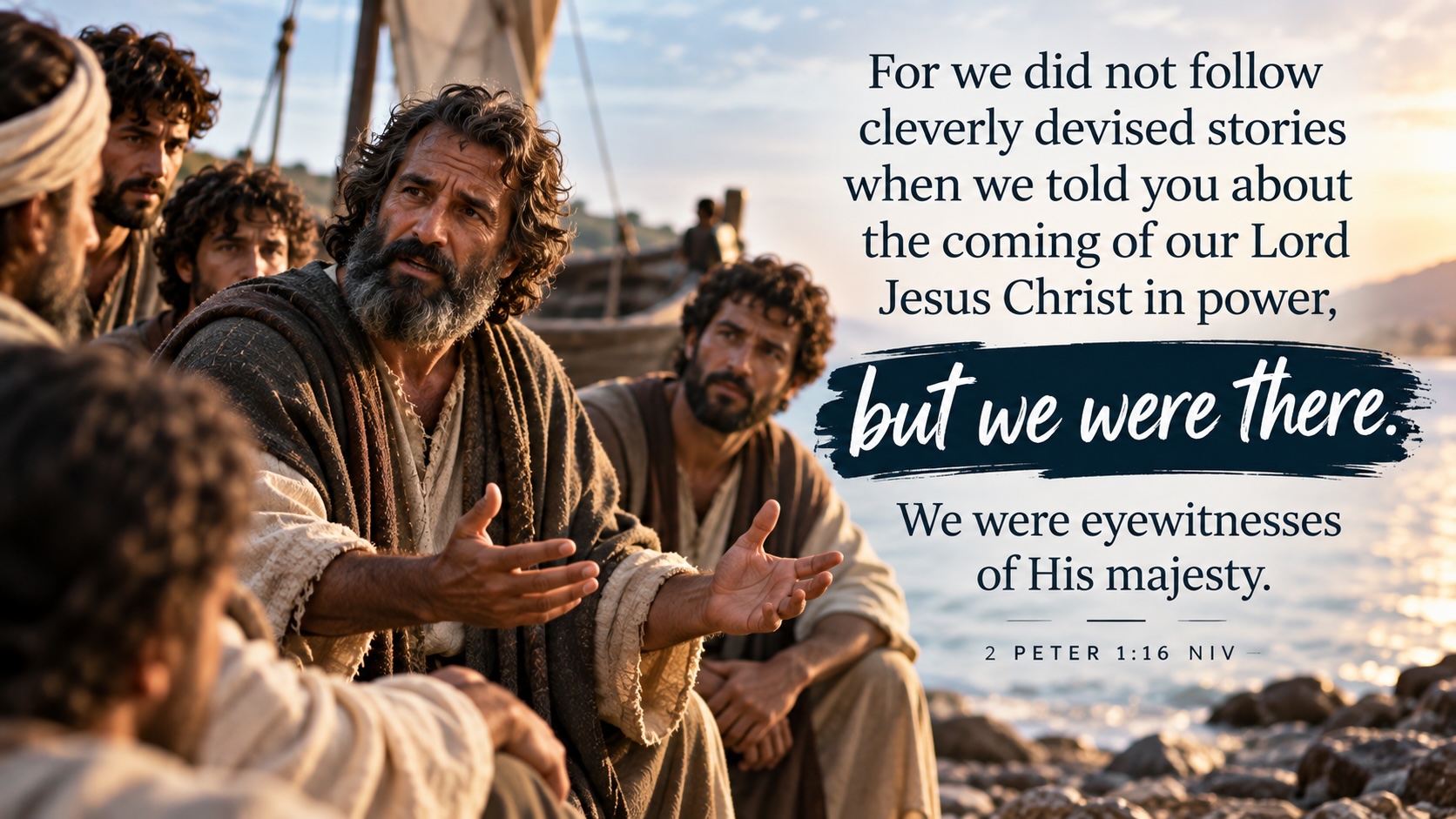
“For we did not follow cleverly invented stories when we told you about the power and coming of our Lord Jesus Christ, but we were eyewitnesses of his majesty.” — 2 Peter 1:16
Notice what Peter specifically denies: “cleverly invented stories.” His response was essentially: WE WERE THERE.
Whether someone ultimately accepts Peter’s testimony is a question each person must consider, but we shouldn’t miss what Peter himself claimed. He was presenting his message about Jesus as eyewitness testimony.
Why Do Some Bibles Say “Devised” and Others Say “Invented”?
Depending on the Bible translation you read, Peter’s words may appear as “cleverly devised stories,” “cleverly invented stories, “cleverly devised myths,” “cunningly devised fables,” or similar wording. These translations are expressing the same basic idea from the original Greek word is sesophismenoi (from sophizō). Peter was making an important distinction: the disciples were not passing along a story someone had cleverly created or invented. His reason was simple—they were eyewitnesses. Peter wasn’t saying, “Someone told us this happened.” He was saying, in effect, “We were there. We saw Him.” That is what makes 2 Peter 1:16 so important when examining the testimony about Jesus.
.
Luke Investigated the Accounts
Luke gives us another perspective. He wasn’t simply writing down stories he happened to hear. At the beginning of his Gospel, Luke explains that accounts had been handed down by people who were “eyewitnesses and servants of the word.”
Luke then says:
“I myself have carefully investigated everything from the beginning…” — Luke 1:3
Luke wanted to provide an orderly account so his reader could know the certainty of what he had been taught. That tells us something important. Questions about what actually happened were being considered from the earliest days of Christianity.
The Resurrection Was Presented With Witnesses
The greatest claim Christianity makes about Jesus isn’t simply that He lived. It is that Jesus died and rose from the dead. And once again, the New Testament points toward witnesses.
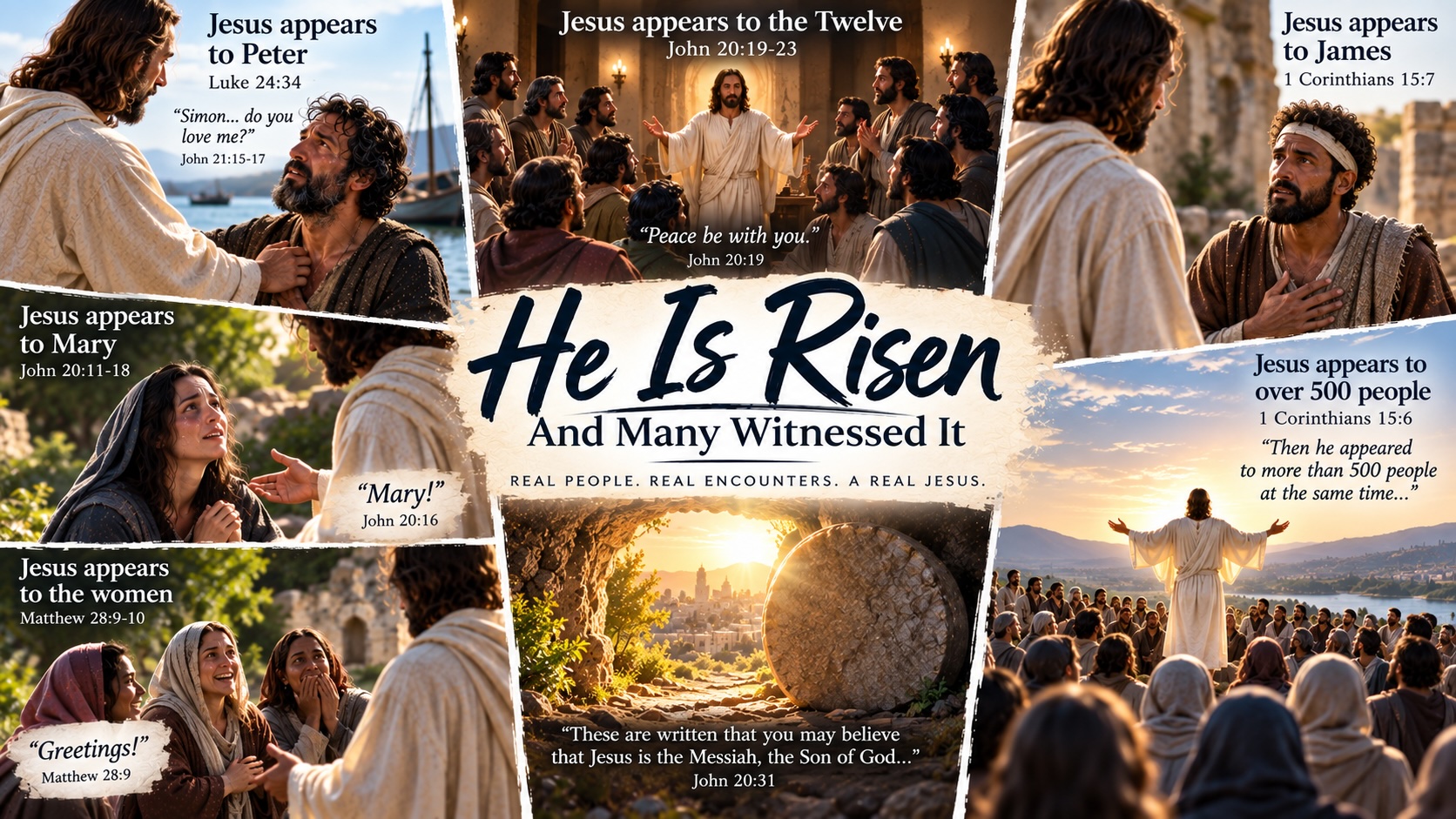
Paul records an early Christian proclamation in 1 Corinthians 15. He says Christ died, was buried and was raised on the third day. Paul then lists appearances to Peter, the Twelve, James, the apostles and others.
He even writes that Jesus appeared to more than 500 people at the same time, adding that many of them were still living when he wrote. Why mention that?
Because Christianity was not originally presented merely as: “Believe this spiritual idea.” The message was: Something happened—and there were people who said they saw Him alive.
Even Thomas Doubted
One of my favorite parts of the resurrection story involves someone who wasn’t immediately convinced. Thomas. When the other disciples told Thomas they had seen Jesus alive, Thomas didn’t simply believe them.
- He wanted evidence.
- He wanted to see the wounds.
- He wanted to touch them.
Then Jesus appeared to him. Jesus told Thomas:
“Put your finger here; see my hands. Reach out your hand and put it into my side. Stop doubting and believe.” — John 20:27
Thomas responded:
“My Lord and my God!” — John 20:28
I think Thomas matters because many people today have the same reaction: I need more than someone telling me to believe.
The Bible doesn’t hide Thomas’ doubt. It records it.
Jesus Appeared to His Disciples
Luke records another remarkable encounter after the resurrection. The disciples were frightened when Jesus appeared because they thought they were seeing a spirit.
Jesus told them to look at His hands and feet and said:
“Why are you troubled, and why do doubts rise in your minds? Look at my hands and my feet. It is I myself! Touch me and see; a ghost does not have flesh and bones, as you see I have.” — Luke 24:38-39
He then ate in front of them. Again, the emphasis is physical.
- Seeing.
- Touching.
- Eating.
- Witnessing.
Jesus then told them:
“You are witnesses of these things.” — Luke 24:48
That word keeps appearing. Witnesses.
Were There Records of Jesus Outside the Bible? Is Jesus Real?
YES!
The New Testament is our primary collection of early Christian writings about Jesus, but references to Jesus and the early Christian movement also appear outside the Bible.
Ancient writers including the Jewish historian Flavius Josephus and Roman historian Tacitus wrote passages referring to Jesus or Christ and His followers.
These sources do not prove every Christian belief about Jesus. That isn’t their purpose. But they are important when someone asks the more basic historical questions:
Did Jesus really exist? Is Jesus real?
The existence of Jesus of Nazareth is not dependent upon a single isolated Christian document. There are multiple ancient sources connected to the historical Jesus and the movement that formed around Him.
Jesus didn’t suddenly appear in history without a family or background. Both Matthew and Luke preserve a genealogy of Jesus, connecting Him to generations of people who came before Him.
But Can We Trust Witnesses Who Believed in Jesus?
This is an important question. Someone might say: “Of course Jesus’ followers said He was real. They were Christians.”
That’s worth considering. But it also raises another question: Why did they become believers in the first place?
Some eyewitnesses of Jesus were followers before His death. Others were not.
- Paul had actively opposed Christians.
- James, the brother of Jesus, is portrayed in the Gospels as not initially believing in Him.
- Thomas doubted the resurrection testimony of the other disciples.
Yet all three became associated with the proclamation that Jesus was alive. Their testimony doesn’t force anyone to believe. But it deserves to be examined rather than dismissed without consideration.
Of course, eyewitness testimony raises another important question: Can we trust what the Bible says? If you’ve ever wondered whether Scripture is simply a collection of made-up stories, that’s a question worth examining for yourself.
Is Jesus Real? Separate Two Questions
When people ask “Is Jesus real?”, they may actually be asking two different questions.
Did Jesus of Nazareth really exist?
There are early Christian writings, eyewitness claims, and non-Christian historical references supporting Jesus as a real person in first-century history.
But there is a second—and much bigger—question:
Is Jesus really the Son of God?
History can help us examine documents, people, places and testimony. But John’s Gospel asks us to consider something beyond Jesus’ mere existence.
John wanted us to decide what the evidence means. He wrote:
“These are written that you may believe that Jesus is the Messiah, the Son of God…” — John 20:31
You Don’t Have to Be Afraid to Ask Questions
Maybe you’re reading this because you’re a Christian who has struggled with doubt. Maybe someone challenged your faith. Maybe you grew up believing in Jesus but never really investigated why. Or maybe you don’t believe at all.
Ask the questions. Read the accounts. Look at what the witnesses actually said.
Start with the Gospel of John and notice how often words like witness, testimony, see, saw, and believe appear. John doesn’t begin by asking you to pretend you don’t have questions. He presents testimony. And then he tells you why he recorded it.
So that you may believe.
Frequently Asked Questions About Whether Jesus Was Real
Jesus of Nazareth is described extensively in early Christian writings and is also referenced in ancient non-Christian sources. The historical question of Jesus’ existence is different from the theological question of whether He is the Son of God.
The New Testament repeatedly presents people as witnesses of Jesus’ life, ministry and resurrection. John explicitly describes testimony connected to what was seen and heard.
In the NIV, John the Baptist says, “I have seen and I testify that this the Son of God.”
John 21:24 identifies the disciple behind the testimony recorded in the Gospel and says that his testimony is true. It is one of the clearest passages connecting John’s Gospel with eyewitness testimony.
The New Testament records multiple appearances of the risen Jesus. Paul summarizes appearances to Peter, the Twelve, more than 500 people, James, the apostles and finally Paul himself in 1 Corinthians 15:3–8…Witnesses of Jesus’ resurrection.
According to John 20, Thomas initially refused to believe the other disciples’ testimony that Jesus was alive. After encountering Jesus himself, Thomas declared, “My Lord and my God!”
A good place to begin is the Gospel of John. Read it slowly and pay particular attention to who claims to have witnessed Jesus, what they say they saw, and why John says he recorded these events.
Don’t Just Ask, “Was Jesus Real?”
That is a good place to start. But it isn’t where John’s Gospel leaves us. John points toward eyewitnesses of Jesus who said:
- We saw Him.
- We heard Him.
- We touched Him.
- We watched what He did.
- We saw Him after His death.
And John tells us plainly why he recorded their testimony:
“These are written that you may believe that Jesus is the Messiah, the Son of God…” — John 20:31
So perhaps the next question isn’t only: “Was Jesus real?”
Perhaps it is: “If these witnesses were telling the truth, who is Jesus?
Discovering that Jesus was real is only the beginning. The bigger question is who Jesus is and why He came. The Bible connects His life, death and resurrection directly to God’s plan of salvation through Jesus Christ.
If you’re beginning to believe in Jesus and wondering what comes next, you can learn more about how to receive salvation and read a simple Salvation Prayer.