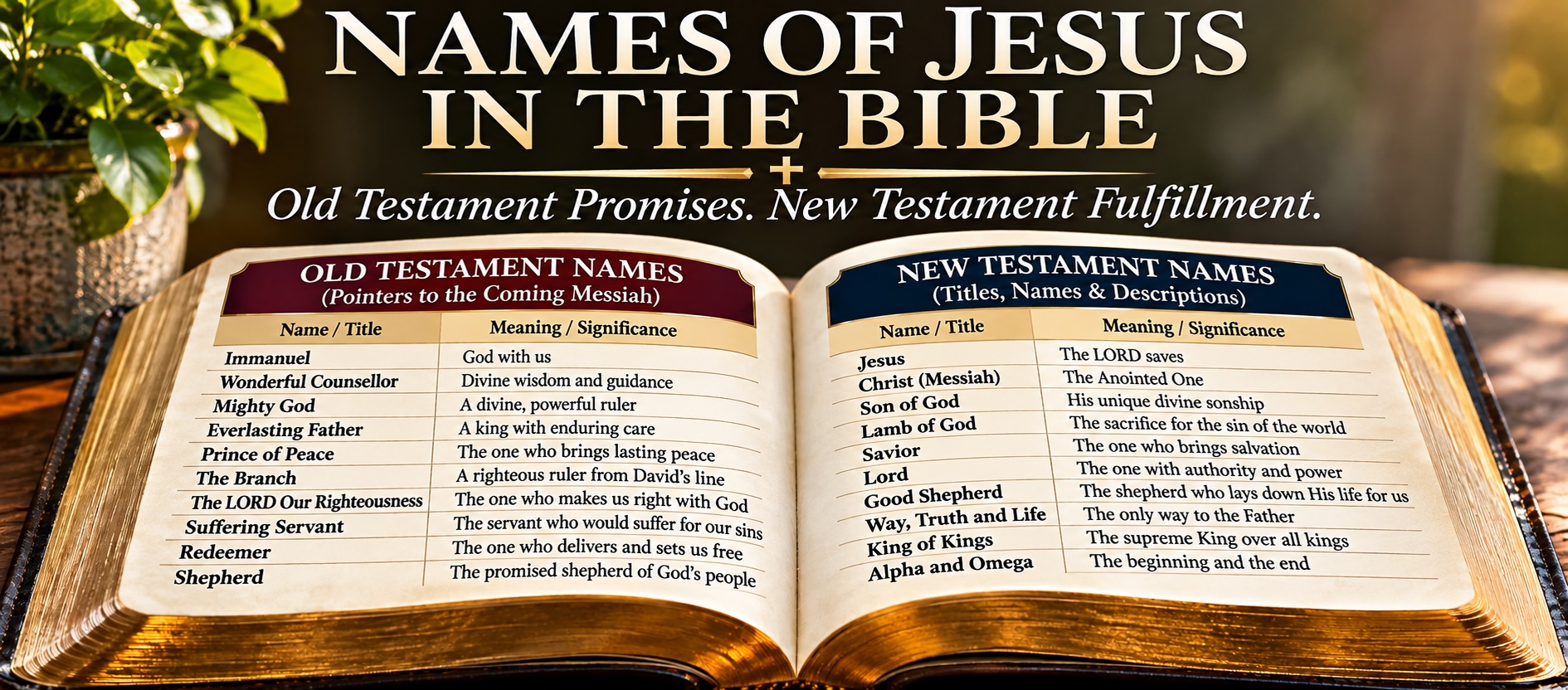
Names of Jesus in the Bible: Old vs. New Testament
Different Names. One Savior. God’s Promise Revealed.
Have you ever noticed how many different names Jesus is called throughout the Bible? Most of us know Him as Jesus Christ, the Son of God, our Lord and Savior, but when we begin reading Scripture more closely, we discover that the Bible describes Him in so many other ways.
He is called the Prince of Peace, the Good Shepherd, the Lamb of God, the Bread of Life, the Alpha and Omega, and many more. But here’s something I find especially fascinating: Long before Jesus was born in Bethlehem, the Old Testament was already pointing toward Him.
Hundreds of years before His birth, the prophets wrote about a coming Messiah, a King, a Savior, and a Servant who would suffer for the sins of others. Then we turn to the New Testament and see how those promises are fulfilled in Jesus Christ.
I believe understanding these names helps us better understand who Jesus really is. And for anyone who believes in God or a higher power but still questions whether Jesus is truly the Son of God, I hope these Scriptures encourage you to look more closely at Him. These names aren’t just descriptions. They tell us about His character, His purpose, His authority, and His love for us.
Why Does Jesus Have So Many Names in the Bible?
In biblical times, names often carried deep meaning. They could describe someone’s character, calling, identity, or purpose. Jesus is no exception. Each name or title reveals something important about Him.
When Scripture calls Him the Good Shepherd, we see His care for His people. When it calls Him the Lamb of God, we see His sacrifice. When it calls Him King of Kings, we see His authority. When He says He is the Way, the Truth, and the Life, we understand that salvation is found through Him.
Let’s look at how the Old Testament prepared the way for Jesus and how the New Testament reveals who He is.
Old Testament Names and Titles That Point to Jesus
The Old Testament was written centuries before Jesus walked the earth. Yet throughout its pages, we find promises, prophecies, and descriptions that Christians understand as pointing to the coming Messiah.
Some of these are direct messianic titles. Others are descriptions that become clearer when we read the New Testament.
|
Name or title |
Scripture |
Meaning or significance |
|---|---|---|
| Immanuel | Isaiah 7:14 | God with us; applied to Jesus in Matthew 1:22–23 |
| Wonderful Counselor | Isaiah 9:6 | The promised child’s extraordinary wisdom and counsel |
| Mighty God | Isaiah 9:6 | A divine title given to the promised child |
| Everlasting Father | Isaiah 9:6 | A royal title expressing enduring, fatherly care; not an identification of Jesus as God the Father |
| Prince of Peace | Isaiah 9:6 | The promised ruler who brings peace |
| The Branch | Jeremiah 23:5–6; Zechariah 6:12 | The righteous ruler from David’s line |
| The LORD Our Righteousness | Jeremiah 23:6 | A name associated with the promised righteous king |
| Ruler from Bethlehem | Micah 5:2 | The promised ruler whose origins are connected to Bethlehem |
| Son of Man | Daniel 7:13–14 | A heavenly figure given everlasting dominion |
| Anointed One (Messiah) | Daniel 9:25–26 | God’s anointed one; interpretation of the prophecy’s referent and timing is debated |
| Suffering Servant | Isaiah 52:13–53:12 | The servant who suffers and bears the sins of others |
| Servant of the LORD | Isaiah 42:1–4 | God’s chosen servant who brings justice |
| Redeemer | Job 19:25; Isaiah 59:20 | One who delivers or redeems; understood in Christian theology in relation to Christ |
| Cornerstone, Capstone | Psalm 118:22; Isaiah 28:16 | The foundation stone, later applied to Jesus |
| Priest Forever | Psalm 110:4 | A priest forever after the order of Melchizedek |
| Son | Psalm 2:7-12 | God’s anointed royal Son; applied to Jesus in the New Testament |
| Star out of Jacob | Numbers 24:17 | A symbol of a coming ruler from Israel |
| Prophet Like Moses | Deuteronomy 18:15–19 | The promised prophet, identified with Jesus in Acts 3:22–23 |
| Root of Jesse | Isaiah 11:1-10 | A promised ruler from David’s family line |
| Shepherd | Ezekiel 34:23–24 | The promised Davidic shepherd of God’s people |
Scripture references use traditional English title wording, primarily familiar from the King James Version. The table includes Christian messianic interpretations, not claims that every passage explicitly names Jesus.
What about the Suffering Servant?
This is one of the most important descriptions of the Messiah in the Old Testament. Isaiah 53 describes someone who would be rejected, suffer, and bear the sins of others.
Isaiah 53:5 (KJV) says:
“But he was wounded for our transgressions, he was bruised for our iniquities: the chastisement of our peace was upon him; and with his stripes we are healed.”
Isaiah 53:5 (NIV) says:
“But he was pierced for our transgressions, he was crushed for our iniquities; the punishment that brought us peace was on him, and by his wounds we are healed.”
Yesha’yahu (Isaiah – Jewish Bible) says:
“But he was wounded because of our crimes, crushed because of our sins; the disciplining that makes us whole fell on him, and by his bruises we are healed.
Christians see a remarkable connection between this passage and the suffering, crucifixion, and resurrection of Jesus. It’s also important to understand that Jewish interpretations of the servant passages differ, including interpretations that identify the servant with Israel. We should acknowledge that difference rather than suggest everyone agrees on the passage’s meaning.
For me, reading Isaiah 53 alongside the Gospel accounts is especially powerful.
New Testament Names and Titles of Jesus Christ
When we reach the New Testament, Jesus is no longer simply the subject of promises about someone to come. He has entered the world.
The Gospels tell us about His birth, ministry, miracles, teachings, death, and resurrection. And throughout the New Testament, we discover even more names that explain who He is.
|
Name or title |
Scripture |
Meaning or significance |
|---|---|---|
| Jesus | Matthew 1:21 | The LORD saves; He saves His people from their sins |
| Christ | Matthew 16:16 | The Messiah, or Anointed One |
| Immanuel | Matthew 1:23 | God with us |
| Son of God | John 3:16; Matthew 16:16 | His unique divine sonship |
| Son of Man | Mark 10:45; Matthew 26:64 | His identification with humanity and the figure of Daniel 7 |
| Lamb of God | John 1:29 | The one who takes away the sin of the world |
| Savior | Luke 2:11; John 4:42 | The Savior of the world |
| Lord | Romans 10:9; Philippians 2:11 | His divine authority and lordship |
| Word of God | John 1:1, 1:14; Revelation 19:13 | God’s eternal Word made flesh |
| Bread of Life | John 6:35 | The one who gives spiritual life |
| Light of the World | John 8:12 | The one who leads us out of spiritual darkness |
| Good Shepherd | John 10:11 | The shepherd who lays down His life for His sheep |
| Gate of the Sheep | John 10:7–9 | The entrance to salvation and safety |
| Resurrection and the Life | John 11:25 | The source of resurrection and eternal life |
| Way, Truth, and Life | John 14:6 | The only way to the Father |
| True Vine | John 15:1 | The source of spiritual life and fruitfulness |
| King of Kings | Revelation 19:16 | Supreme King over all rulers |
| Lord of Lords | Revelation 19:16 | Supreme Lord over all authority |
| Alpha and Omega | Revelation 22:13 | The beginning and the end |
| First and Last | Revelation 1:17; 22:13 | His eternal nature and authority |
| Bright and Morning Star | Revelation 22:16 | The promised royal Messiah and source of hope |
| Lion of the Tribe of Judah | Revelation 5:5 | The victorious Messiah from Judah |
| Root and Offspring of David | Revelation 5:5, Revelation 22:16 | Both David’s source and his descendant |
| Holy One of God | John 6:69 | The one uniquely set apart by God |
| Bridegroom | Mark 2:19–20; John 3:29 | The one whose people are pictured as His bride |
| Mediator | 1 Timothy 2:5 | The one mediator between God and humanity |
| Advocate | 1 John 2:1 | The one who intercedes for believers |
| Righteous One | 1 John 2:1 | The righteous one who intercedes for believers |
| High Priest | Hebrews 4:14–15 | The one who represents us before God |
| Author and Finisher of Our Faith | Hebrews 12:2 | The founder / pioneer and perfecter of faith |
| Last Adam | 1 Corinthians 15:45 | The one who brings life where Adam brought death |
| Chief Cornerstone | Ephesians 2:20; 1 Peter 2:6 | The foundation of God’s people |
| Head of the Church | Colossians 1:18 | The one who leads His church |
| Image of the Invisible God | Colossians 1:15 | The perfect revelation of God |
| Beloved Son | Matthew 3:17 | The Son in whom the Father is well pleased |
| Faithful and True | Revelation 19:11 | The righteous and trustworthy judge |
| Amen | Revelation 3:14 | The faithful and true witness |
| Deliverer | Romans 11:26 | The one who brings deliverance |
| Author of Life | Acts 3:15 | The source and author of life |
| Great Shepherd of the Sheep | Hebrews 13:20 | The risen shepherd of God’s people |
Some of these names were spoken by Jesus Himself. Others were spoken by the apostles, angels, or other witnesses. But together, they reveal a consistent message about His identity and mission.
Old vs. New Testament: How the Names of Jesus Connect
This is where I think the Bible becomes so interesting. We can read a description in the Old Testament and then turn to the New Testament and see how that same description is connected to Jesus.
These are some of the clearest examples.
|
Old Testament |
New Testament fulfillment or connection |
|---|---|
| Immanuel — Isaiah 7:14 | Jesus, God with us — Matthew 1:23 |
| Prince of Peace — Isaiah 9:6 | Jesus brings peace — John 14:27 |
| Ruler from Bethlehem — Micah 5:2 | Jesus born in Bethlehem — Matthew 2:1–6 |
| Suffering Servant — Isaiah 53:4–7 | Jesus’ suffering — Acts 8:32–35; 1 Peter 2:24 |
| Son of Man — Daniel 7:13–14 | Jesus identifies Himself with this figure — Mark 14:61–62 |
| Rejected Stone — Psalm 118:22 | Jesus the Cornerstone — Acts 4:10–11 |
| Prophet Like Moses — Deuteronomy 18:15 | Peter identifies Jesus as the promised prophet — Acts 3:22–23 |
| Priest Forever — Psalm 110:4 | Jesus our eternal High Priest — Hebrews 5:5–10 |
| Shepherd — Ezekiel 34:23 | Jesus the Good Shepherd — John 10:11 |
| Root of Jesse — Isaiah 11:10 | Jesus the Root of David — Revelation 22:16 |
| Anointed King — Psalm 2:2 | Jesus the Christ — Acts 4:25–27 |
| Star out of Jacob — Numbers 24:17 | Jesus the Bright Morning Star — Revelation 22:16 |
These connections matter because Christianity doesn’t begin with the birth of Jesus in Bethlehem. The New Testament presents Jesus as the fulfillment of God’s promises recorded throughout the Old Testament.
Not every pairing is a direct prediction-and-fulfillment statement. Some are theological connections or shared images. But together, they show why Christians believe the entire Bible points toward Jesus Christ.
What Do the Names of Jesus Tell Us About Who He Is?
When I look at all these names together, I don’t see a collection of unrelated titles. I see different ways Scripture helps us understand the same Savior.
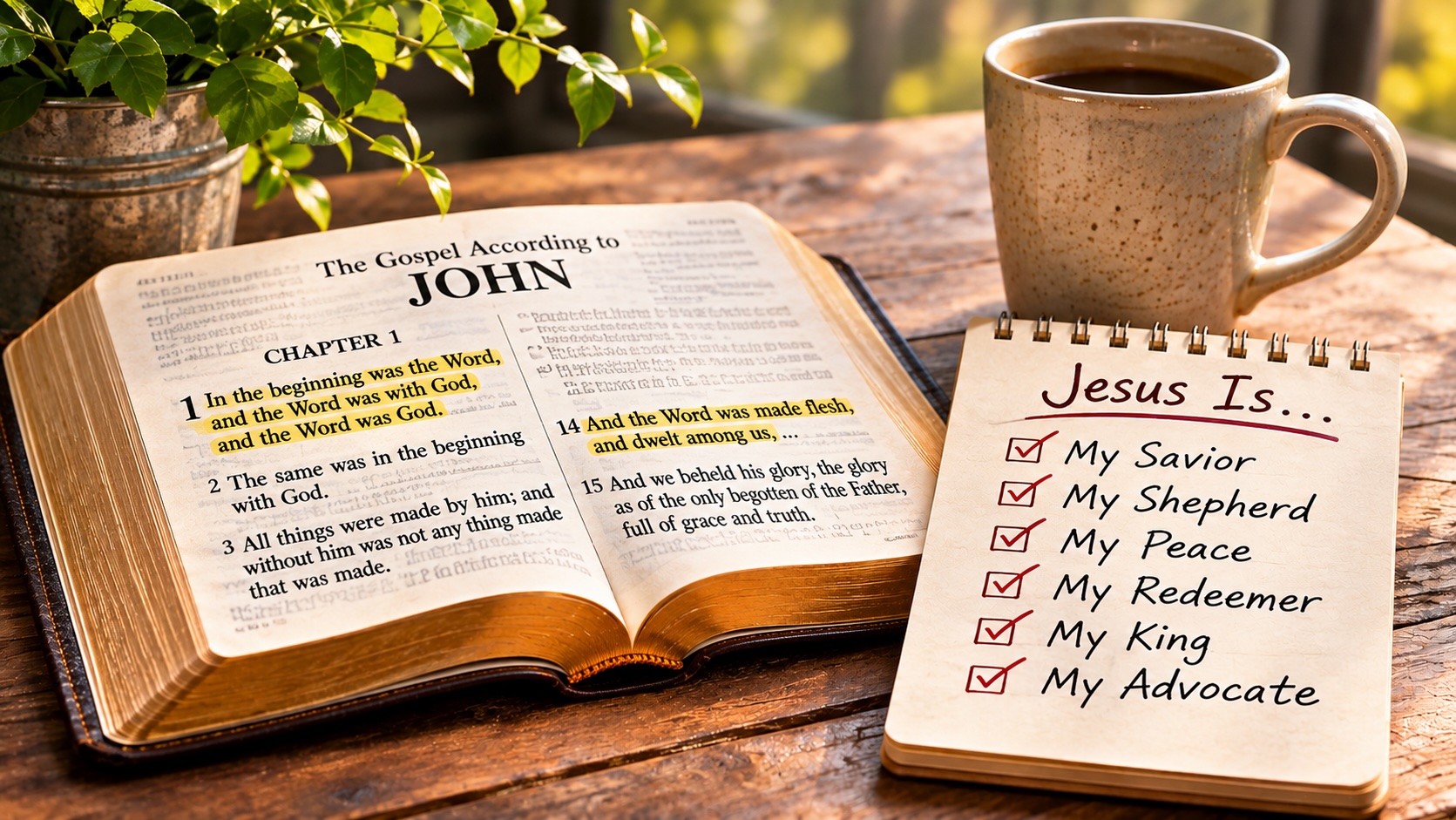
- He is our Savior. Matthew 1:21 tells us why He was given the name Jesus: He would save His people from their sins.
She will give birth to a son, and you are to give him the name Jesus, because he will save his people from their sins.” – Matthew 1:21
- He is our Shepherd. In John 10:11, Jesus says He is the Good Shepherd who gives His life for the sheep.
“I am the good shepherd. The good shepherd lays down his life for the sheep. – John 10:11
- He is our Peace. Isaiah calls the promised child the Prince of Peace, and in John 14:27, Jesus tells His disciples that He gives them His peace.
Peace I leave with you; my peace I give you. I do not give to you as the world gives. Do not let your hearts be troubled and do not be afraid. – John 14:27
- He is our Redeemer. Ephesians 1:7 teaches that through Christ’s blood, we have redemption and forgiveness of sins.
In him we have redemption through his blood, the forgiveness of sins, in accordance with the riches of God’s grace – Ephesians 1:7
- He is our King. Revelation 19:16 calls Him King of Kings and Lord of Lords.
On his robe and on his thigh he has this name written: KING OF KINGS AND LORD OR LORDS. – Revelation 19:16
And perhaps one of the most important things to understand is that Jesus isn’t simply another prophet, teacher, or good man.
John 1:1 and 1:14 teach that the Word was God and that the Word became flesh. This is foundational to the Christian understanding of Jesus’ divine identity.
In the beginning was the Word, and the Word was with God, and the Word was God. – John 1:1
The Word became flesh and made his dwelling among us. We have seen his glory, the glory of the one and only Son, who came from the Father, full of grace and truth. – John 1:14
Jesus Is More Than a Name!
I often think about how easily we can become familiar with the name Jesus without fully understanding who He claimed to be. He didn’t simply tell people how to find eternal life.
He said:
“Jesus saith unto him, I am the way, the truth, and the life: no man cometh unto the Father, but by me.” — John 14:6 (KJV)
That is an extraordinary claim!
Jesus wasn’t presenting Himself as one of many paths to God. He was declaring that He is the way to the Father. That’s why understanding His names is so important. They aren’t just beautiful words. They reveal what Scripture teaches about His identity and why He came into the world.
Why the Names of Jesus Matter Today
There are many people who believe in God, believe there is a higher power, or believe that Jesus was a good teacher, but aren’t convinced He is the Savior. If that’s you, I encourage you to read these passages for yourself. Don’t simply take my word for it. Open your Bible and compare the Old Testament passages with the New Testament. Look at what the prophets wrote. Read what Jesus said about Himself. Look at what His disciples witnessed and taught.
I believe the more we study Scripture, the clearer the connection becomes. If you’re already a Christian, I hope these names remind you that Jesus is so much more than someone we pray to when life gets difficult.
He is our Lord, our Shepherd, our Advocate, our Redeemer, and our Savior. The same Jesus who willingly went to the cross is the risen Lord whom Scripture calls King of Kings.
Frequently Asked Questions About the Names of Jesus in the Bible
There is no universally agreed-upon number. Depending on whether you count personal names, titles, descriptions, and symbolic references, there are dozens of names and titles associated with Jesus throughout Scripture.
The Old Testament does not explicitly identify Jesus of Nazareth by His New Testament personal name. However, Christians believe many Old Testament prophecies, titles, and descriptions point to Him, including the promised Messiah, the Suffering Servant, and the ruler from Bethlehem.
Jesus comes through the Greek Iēsous from the Hebrew/Aramaic name Yeshua, related to Yehoshua (Joshua). Its meaning is commonly expressed as “The LORD saves.” Matthew 1:21 directly connects His name with His mission to save His people from their sins.
No. Christ is a title, not a surname. It comes from the Greek Christos, meaning “Anointed One,” corresponding to the Hebrew Messiah.
Yes. Matthew 1:23 applies Isaiah’s prophecy of Immanuel, meaning “God with us,” to Jesus. It describes His identity rather than functioning as His everyday personal name.
John the Baptist calls Jesus the Lamb of God in John 1:29. This title connects Jesus’ sacrificial death with biblical themes of sacrifice, redemption, and the removal of sin.
Historic Christianity teaches that Jesus is fully God and fully man. The Father, Son, and Holy Spirit are distinct persons, yet one God. John 1:1, John 1:14, and John 20:28 are important passages concerning Jesus’ deity.
The Bible doesn’t rank His names in order of importance. However, His personal name, Jesus, directly expresses His saving mission, while titles such as Christ, Lord, and Son of God reveal essential aspects of His identity.
Final Thoughts: Different Names, One Savior
I hope this article encourages you to see Jesus in a deeper way.
The Old Testament points us toward the promised Messiah, and the New Testament reveals Jesus as the fulfillment of God’s saving promises. He is the Prince of Peace when our world feels anything but peaceful. He is the Good Shepherd when we feel lost. He is our Advocate when we fall short. And He is our Savior because none of us can save ourselves.
The names may be different, but they lead us to the same Jesus Christ. My hope is that whether you’ve known Him for years or are just beginning to question who He really is, you’ll continue searching the Scriptures.
Knowing the names of Jesus is wonderful, but knowing Jesus Himself is what truly matters.